" height="24px" id="WCm44spAV" width="24px"/><path d="M 3.892 7.742 C 1.674 7.742 0 6.014 0 3.882 C 0 1.738 1.589 0 3.892 0 C 5.107 0 5.951 0.374 6.623 1.173 L 5.566 2.09 C 5.118 1.621 4.564 1.386 3.892 1.386 C 2.452 1.386 1.547 2.517 1.547 3.882 C 1.547 5.246 2.452 6.356 3.924 6.356 C 4.649 6.356 5.193 6.111 5.63 5.63 L 6.718 6.558 C 6.153 7.24 5.193 7.742 3.892 7.742 Z" fill="rgb(255, 255, 255)" height="7.741500000000002px" id="XEPpGD7l5" transform="translate(4 8.25)" width="6.717999999999989px"/><path d="M 2.74 7.922 C 1.215 7.922 0 6.632 0 5.032 C 0 3.433 1.215 2.122 2.74 2.122 C 3.7 2.122 4.201 2.516 4.5 3.113 L 4.5 2.239 L 5.928 2.239 L 5.928 7.784 L 4.531 7.784 L 4.531 6.877 C 4.233 7.507 3.731 7.922 2.74 7.922 Z M 1.439 5.023 C 1.439 5.865 2.057 6.622 2.975 6.622 C 3.924 6.622 4.531 5.897 4.531 5.033 C 4.531 4.169 3.924 3.423 2.975 3.423 C 2.057 3.423 1.439 4.159 1.439 5.022 Z M 6.784 7.784 L 6.784 0 L 8.224 0 L 8.224 7.784 L 6.784 7.784 Z" fill="rgb(255, 255, 255)" height="7.9224997406005855px" id="lGDJupIUR" transform="translate(10.5 8)" width="8.223500194549558px"/></g></svg>)
" width="18px"><path d="M 2 8 C 0.895 8 0 7.105 0 6 L 0 2 C 0 0.895 0.895 0 2 0 L 6 0 C 7.105 0 8 0.895 8 2 L 8 6 C 8 7.105 7.105 8 6 8 Z" fill="transparent" height="8px" id="ZrCrI93dV" stroke-dasharray="" stroke-linecap="round" stroke-linejoin="round" stroke-width="2" stroke="rgb(0, 0, 0)" width="8px"/><path d="M 0 0 L 0 4 C 0 5.105 0.895 6 2 6 L 6 6" fill="transparent" height="6px" id="emltWYAiE" stroke-dasharray="" stroke-linecap="round" stroke-linejoin="round" stroke-width="2" stroke="rgb(0, 0, 0)" transform="translate(4 8)" width="6px"/><path d="M 2 8 C 0.895 8 0 7.105 0 6 L 0 2 C 0 0.895 0.895 0 2 0 L 6 0 C 7.105 0 8 0.895 8 2 L 8 6 C 8 7.105 7.105 8 6 8 Z" fill="transparent" height="8px" id="WpBecYDfi" stroke-dasharray="" stroke-linecap="round" stroke-linejoin="round" stroke-width="2" stroke="rgb(0, 0, 0)" transform="translate(10 10)" width="8px"/></g></svg>)

By

Cédric van Ravesteijn
Top 10 React Scheduler Component Libraries | Cal.com
Ask for a React scheduler recommendation, and you'll usually get a list of tools without much context on which one is actually right for your project.
Most React scheduler libraries offer day, week, and month views with drag-and-drop support, so it's easy to think they're all similar. The differences become clear when you compare pricing, resource and timeline views, and how much scheduling logic you still have to build yourself.
That's one reason Cal.com stands out. Instead of giving you just the UI, its React components come with a built-in availability engine. Calendar sync, double-booking prevention, and timezone handling are included instead of becoming separate backend projects.
This is important because it’s a common pain point. Many developers realize after shipping a prototype that they still need to build availability rules, Google and Outlook Calendar syncing, and recurring events that work correctly across daylight saving time changes.
To help you avoid those surprises, we compared each library using its official documentation, pricing information, and real-world developer feedback.
Every library is evaluated on:
Licensing clarity: How easy it is to understand commercial pricing.
Scheduling depth: Support for resource and timeline views, recurring events, and timezone handling.
Integration effort: How much backend work is required beyond the UI.
You'll also find a comparison table near the end that scores all 10 libraries across these criteria, so you can quickly narrow down the best fit for your use case.
TL;DR: the 10 best React scheduler component libraries
Cal.com: best for teams building booking into their product
FullCalendar: best for broad framework support on a free core
Bryntum Scheduler: best for heavy resource and timeline scheduling
Syncfusion React Scheduler: best for teams that want one vendor for every control
KendoReact Scheduler: best for enterprise design system consistency
DevExtreme React Scheduler: best for predictable commercial redistribution
Mobiscroll: best for mobile first scheduling interfaces
DHTMLX Scheduler: best for perpetual licensing on a fixed budget
MUI X Scheduler: best for teams already standardized on Material UI
react-big-calendar: best free React calendar library for straightforward event views
What are React scheduler component libraries?
React scheduler component libraries are UI packages that turn arrays of events into interactive calendar views. You install one from npm, pass in your events and resources, add handlers for creating, moving, and resizing events, and you get a calendar your users can work with.
They don't all solve the same problem, though. Four different types of tool get grouped under the same label, and each does a different job:
Date pickers let a user select a day or a date range for a form field. Small and cheap, but not enough if users need to see a whole week.
Event calendars render day, week, month, and agenda views. A React calendar scheduler like FullCalendar, react-big-calendar, or the MUI X Event Calendar sits here.
Resource schedulers put resources on rows and time across the horizontal axis, so you can see six technicians or four rooms across a single day. Bryntum, DHTMLX, and Mobiscroll timeline views work this way.
Booking layers own availability itself: which slots are genuinely free, across whose calendars, under what rules, and what happens once someone books one. Cal.com sits here and provides React components on top.
Most scheduling apps need at least two of these layers, and that's the part teams underestimate.
A calendar grid will draw whatever events you hand it. Working out which slots are bookable, checking them against a host's Google and Outlook calendars, holding one while a user fills in a form, and writing the event back is backend work the grid never touches.
If you're building a React appointment scheduler where customers pick their own times, budget for both layers.
What to look for in a React scheduler component library
Here are key areas to look out for when choosing a React scheduler component library for your project:
Licensing that matches your business model. This is the biggest trap in the category. Several libraries are cheap for an internal tool and expensive or not permitted in a product you sell. Bryntum requires an OEM license for SaaS. Mobiscroll's internal project licenses can't be used in multi customer software. The free DHTMLX Standard Edition is GPL v2.0, so it's only free if your own code is GPL compatible. Read the license before the feature list.
Per developer or per project pricing. Per developer pricing adds up fast. A four person team on a $600 per developer library is a $2,400 line item, and most vendors require a license for anyone who touches the source, not just the person wiring up the component. Per project pricing stays flat as the team grows.
Resource and timeline views. If you're scheduling people, rooms, or equipment rather than meetings, you need resources on rows. Check whether that view is in the free tier, because it usually isn't. FullCalendar puts Timeline View and Vertical Resource View behind Premium, and KendoReact keeps the Scheduler out of its free tier entirely.
Recurrence and daylight saving handling. Weekly recurring events are simple until a clock change lands mid series and every instance after it shifts by an hour. Ask whether recurrence is daylight saving aware, and whether the library supports exception dates for the one week someone moved the standup.
Real calendar connections. Most of these libraries render events and stop there. If your users expect bookings to appear in Google Calendar or Outlook, and their existing meetings to block availability, that means OAuth flows, token refresh, syncing, and conflict checking that you either build or buy.
Bundle weight and framework fit. Check peer dependency ranges against the React and Next.js versions you're on. Also check whether the library pulls in a date library, a styling system, or a design language you didn't plan for, since a Material Design calendar in a non Material app takes real CSS work to fix.
The 10 best React scheduler component libraries
1. Cal.com: best React scheduler component library for teams building booking into their product
Free plan? | Starting price | Standout feature | Best use case |
|---|---|---|---|
Yes, free forever for one user | $16/user/month | React components backed by a live availability and calendar sync engine | Any product where customers book appointments |
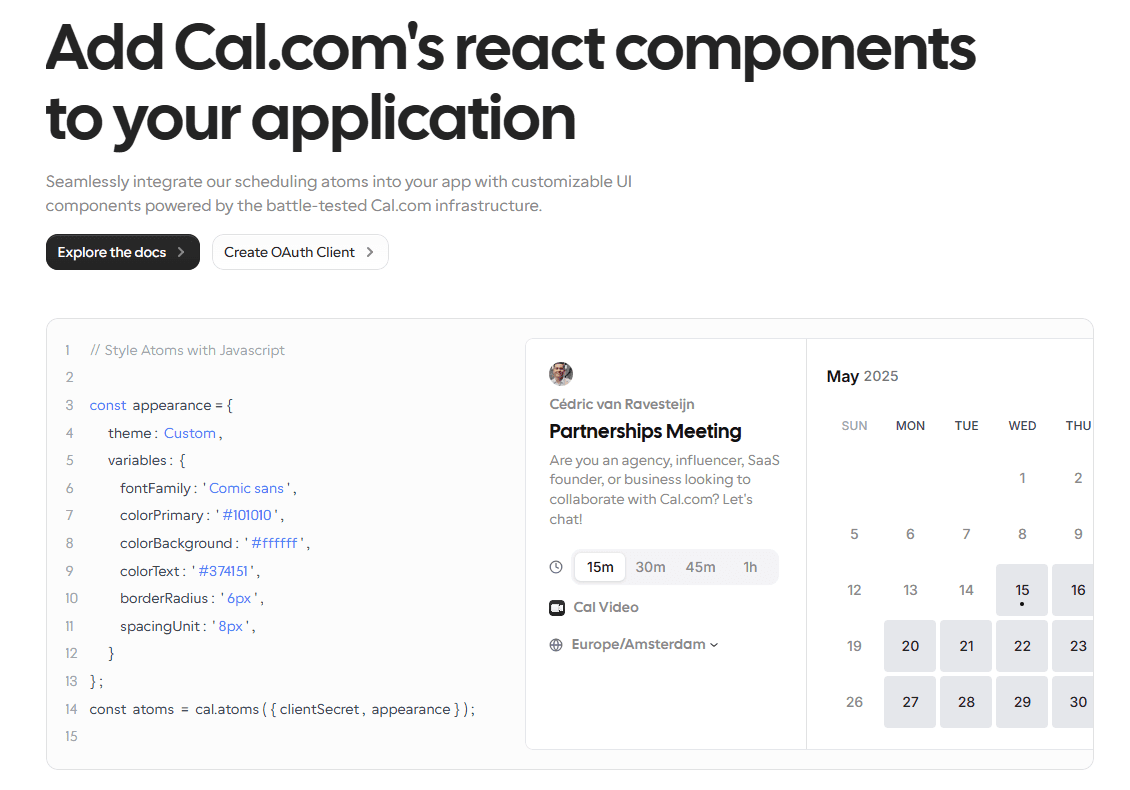
What it is: Cal.com is API first scheduling infrastructure, and Cal.com Atoms is its React component library. You install @calcom/atoms, wrap your app in CalProvider, and drop in components: Booker for the booking flow, AvailabilitySettings for working hours and date overrides, EventTypes and EventTypeSettings for configuring what can be booked, and connect components for Google, Outlook, and Apple calendars. Users authorize through OAuth, and the components call the API on their behalf.
Why it ranks first: Every other library here draws a calendar. Cal.com draws the calendar and knows which slots are genuinely free. The components sit on a scheduling engine that already handles conflict checking across connected calendars, timezone detection, buffers, and minimum notice. In a product where customers book appointments and money or clinical time is attached to them, that logic is the bulk of the work.
Key features:
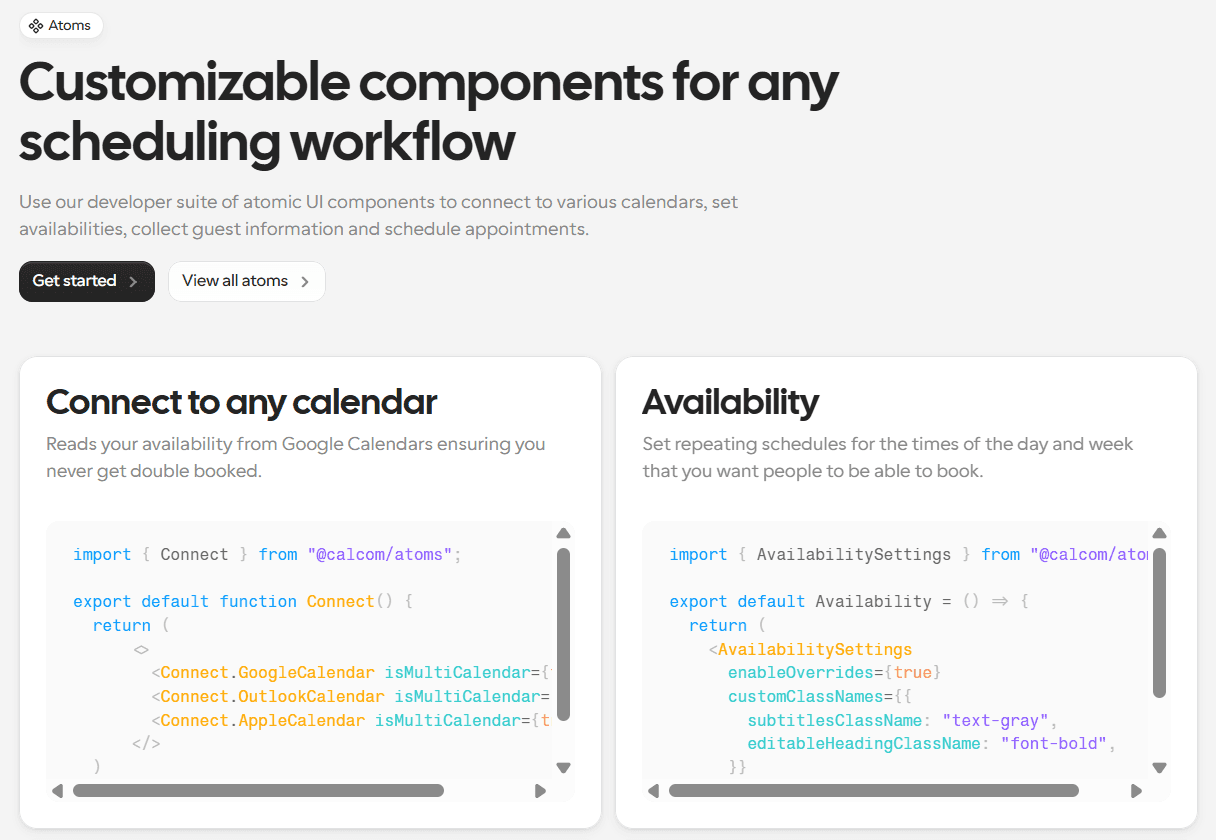
Prebuilt React components. Booker, AvailabilitySettings, EventTypes, CalendarSettings, and thirty plus more ship in one package, so the booking flow and the settings screens come from the same library.
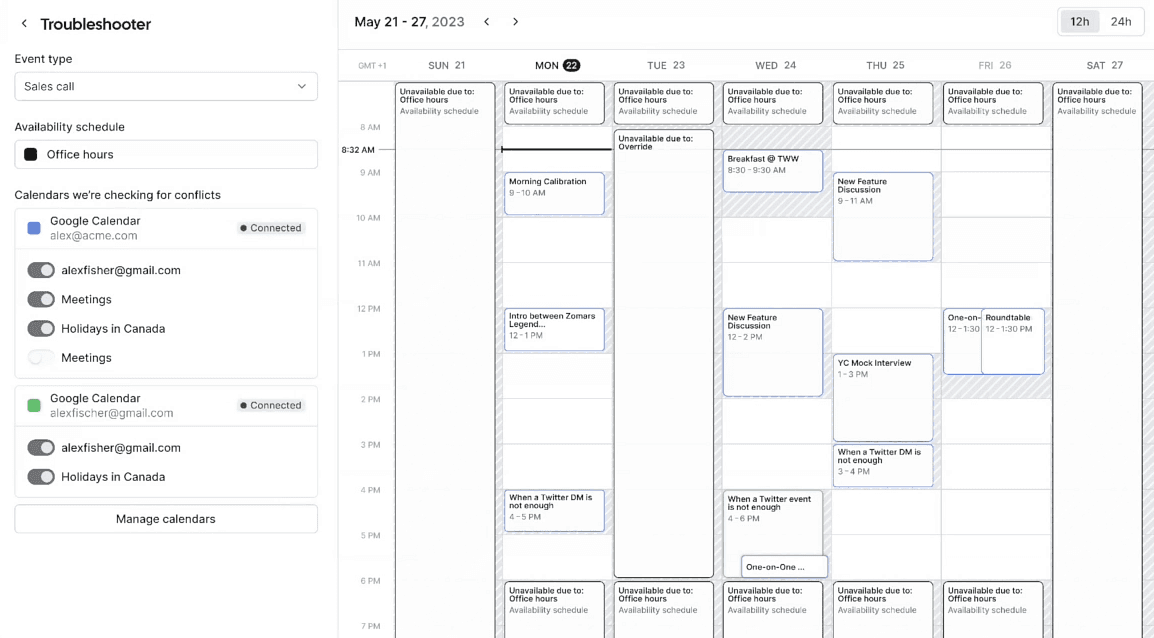
Availability engine behind the UI. Timezone detection, conflict checking, buffers before and after events, minimum notice, and booking frequency limits are enforced by the platform rather than by your code.
Native calendar connections. Google Calendar, Outlook, and Apple Calendar connect components handle the OAuth flow, and synced calendars block availability in both directions.
CSS level customization. Every atom accepts a customClassNames prop, so you style the booking flow with your own classes instead of overriding a vendor theme.
Localization built in. Pass a translations object to any atom to run the booking experience in multiple languages.
Payments on bookings. Stripe Connect and payment form atoms let you take payment during the booking rather than chasing it afterward.
API first infrastructure. A public v2 API and webhooks sit behind the components, so anything the UI can do is available to your backend too.
Team distribution logic. Round robin, collective and managed event types, routing forms, and attribute based routing send each booking to the right person without custom assignment rules.
Full white label. Remove Cal.com branding and use your own domain, so the booking experience reads as your product.
Compliance included. SOC 2, ISO 27001, GDPR, and HIPAA with a signed BAA are available on the Organizations plan, which matters as soon as you're booking anything clinical.
Pricing: The Atoms package installs from npm at no cost, so what you pay for is the Cal.com account behind it. The Free plan covers one user with unlimited event types and calendar connections, which is enough to build and demo a working booking flow. Teams at $16 per user per month adds round robin and routing forms, and Organizations at $37 per user per month adds SSO plus SOC 2, ISO 27001, and HIPAA with a BAA. Both are monthly billing figures, and annual billing takes 25% off.
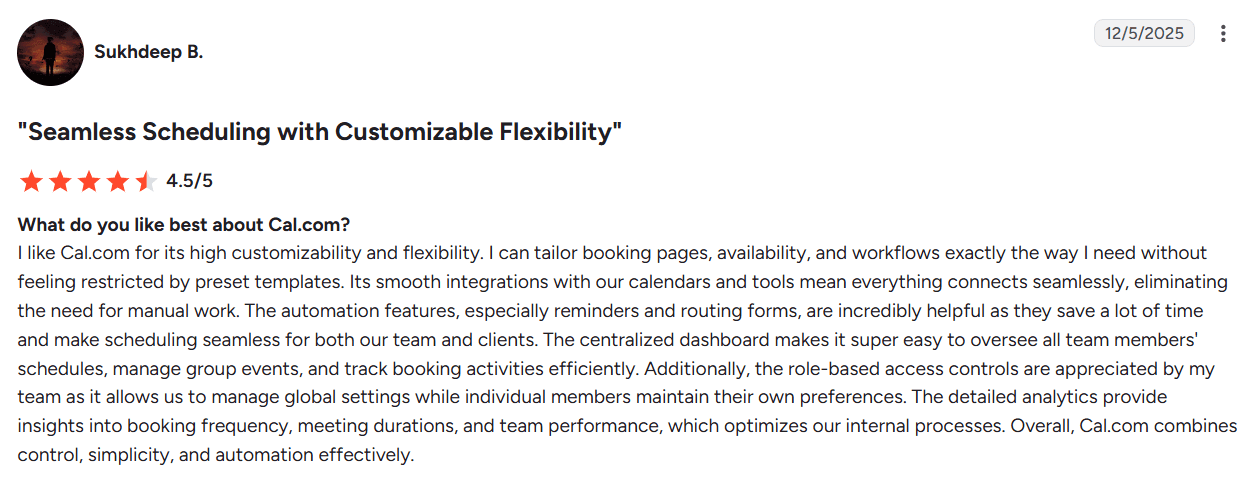
Best for: Product teams building appointment booking, telehealth visits, marketplace matching, or interview scheduling into software they ship to customers, especially when the calendar has to reflect availability that lives somewhere else.
Verdict: Cal.com is the pick when the calendar is the visible part of a much larger feature. Every library here can draw a booking screen. This is the only one that also decides what goes in it. If your users book time with other people, start here.
2. FullCalendar: best React scheduler component library for broad framework support on a free core
Free plan? | Starting price | Standout feature | Best use case |
|---|---|---|---|
Yes, MIT licensed Standard edition | $480 for Premium | Wide adoption and a genuinely usable free tier | Event calendars where resource views are optional |
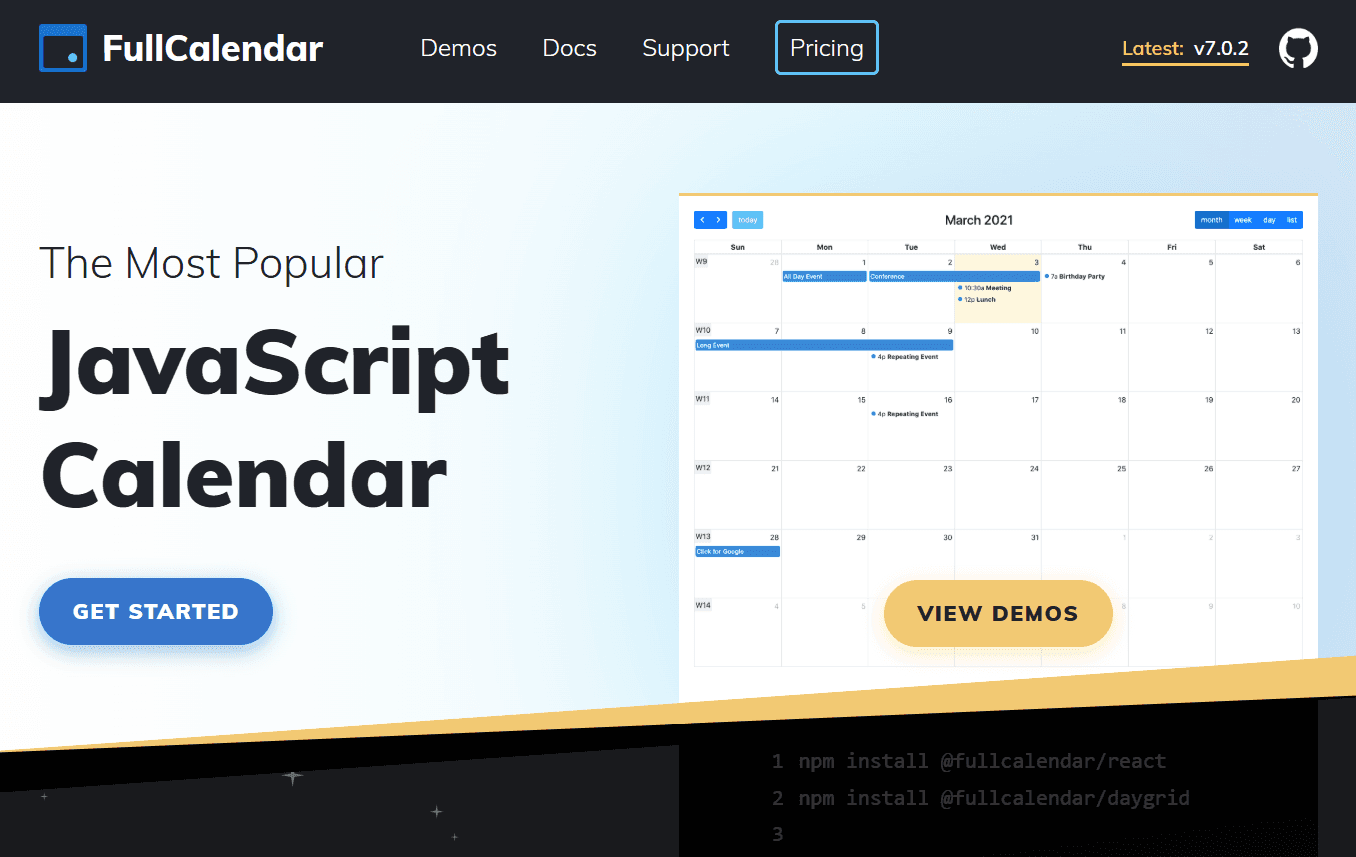
What it is: FullCalendar is the most widely deployed calendar component in the JavaScript ecosystem, and its React connector is a first class integration rather than a community wrapper. The Standard edition covers day, week, month, and list views with drag and drop, recurring events, and iCal and Google Calendar feeds, all under an MIT license. Premium adds the views most people mean when they say scheduler.
Key features:
Official React connector. Vue and Angular connectors exist alongside it, so a team switching frameworks keeps its calendar knowledge.
MIT licensed Standard edition. Hundreds of features, including all core views, drag and drop, and event sources, free for commercial use.
Timeline and vertical resource views. Resources on rows or grouped into columns, available in the Premium edition.
JSX rendering. Event and cell content accept React components, so custom event chips are ordinary React rather than string templates.
Printer friendly rendering. A Premium plugin that makes a week grid print properly, which operations teams ask for more often than you'd expect.
Pricing: Standard is free under MIT. Premium starts at $480 and covers one to ten developers, with email support capped at two tickets a month. Renewing before expiry halves the price, and if you stop renewing you keep using the last version you paid for. Commercial products that let clients edit the source need a license per client or an original equipment manufacturer (OEM) deal.
Pros:
The free tier is complete enough to ship a real event calendar at no cost
A large community means most problems already have a written answer
The perpetual fallback protects you if budget disappears at renewal
One license covers up to ten developers, which is unusually generous here
Cons:
Resource and timeline views sit behind Premium, so teams scheduling staff or rooms hit an unplanned bill
Two support tickets a month means a blocking bug during a crunch can leave you waiting on the community
Open source projects that aren't AGPLv3 compatible lose the free Premium route, which catches teams who assumed GPL terms still applied
The imperative API predates hooks, so keeping it in sync with React state takes extra glue code
Best for: Teams that need a dependable event calendar, want to start without a purchase order, and can work within day, week, and month views or budget for Premium later.
Comparison verdict: FullCalendar is the safest free starting point in this category and a solid choice for an internal event calendar. It draws the events you give it, and deciding which slots are bookable in the first place is still yours to build. Cal.com is the better fit when that decision is the product.
3. Bryntum Scheduler: best React scheduler component library for heavy resource and timeline scheduling
Free plan? | Starting price | Standout feature | Best use case |
|---|---|---|---|
No, 45-day trial | $600 per developer | Virtual rendering that holds up under thousands of events | Dispatch, logistics, and resource planning at scale |
What it is: Bryntum builds the heavyweight end of this category. Scheduler puts resources on rows with time across the top, Scheduler Pro adds an engine that understands dependencies and constraints, and the whole family is designed for datasets that would stall a lighter component. It's what you reach for when a planner needs to see two hundred technicians across a fortnight.
Key features:
Virtual rendering and smart DOM updates. Large datasets stay responsive because only the visible region renders.
Dependencies and constraints. Scheduler Pro understands that one task can't start before another finishes, which most calendar components have no concept of.
Export to PDF, PNG, and Excel. Built in rather than bolted on, which matters for operations teams that work from exported plans.
JSX in events and cells. Custom React components render inside event bars and grid cells.
Source code included. Every license ships the source, so you can read and patch instead of filing a ticket and waiting.
Pricing: Bryntum Scheduler starts at $680 per developer, while Bryntum Scheduler Pro starts at $1,100 per developer for teams building more advanced scheduling applications. Licenses are perpetual and include one year of updates and support. If you're building a commercial SaaS product, you'll need a custom-priced OEM license. Bryntum also offers a discounted Complete Bundle if you need additional UI components like Gantt, Grid, Calendar, and Task Board.
Pros:
Best in class performance on large, dense schedules
Perpetual licensing means you own the version you paid for
Documentation includes live demos and framework specific migration guides
Discounts for charity, education, and unfunded startups under ten employees
Cons:
The OEM requirement means a startup that shifts from internal tool to product faces a renegotiation with no published price to plan against
Per developer, per seat licensing raises the cost every time you add an engineer
The feature surface is large enough that a simple week view takes longer to configure than in lighter libraries
No free tier at all, so evaluation runs on a trial clock rather than at your own pace
Best for: Internal planning and dispatch tools in logistics, field service, manufacturing, and construction, where the schedule is dense and the budget is capital expenditure rather than a per seat subscription.
Comparison verdict: For resource planning at scale, Bryntum is the strongest option here. It schedules resources against work you already know about, rather than letting outside customers claim time. Teams building customer facing booking will move faster with Cal.com and spend far less effort on licensing.
4. Syncfusion React Scheduler: best React scheduler component library for teams that want one vendor for every control
Free plan? | Starting price | Standout feature | Best use case |
|---|---|---|---|
Yes, Community License for small companies | Quote only | Deep timezone handling inside a very large suite | Data heavy apps that need dozens of controls from one vendor |
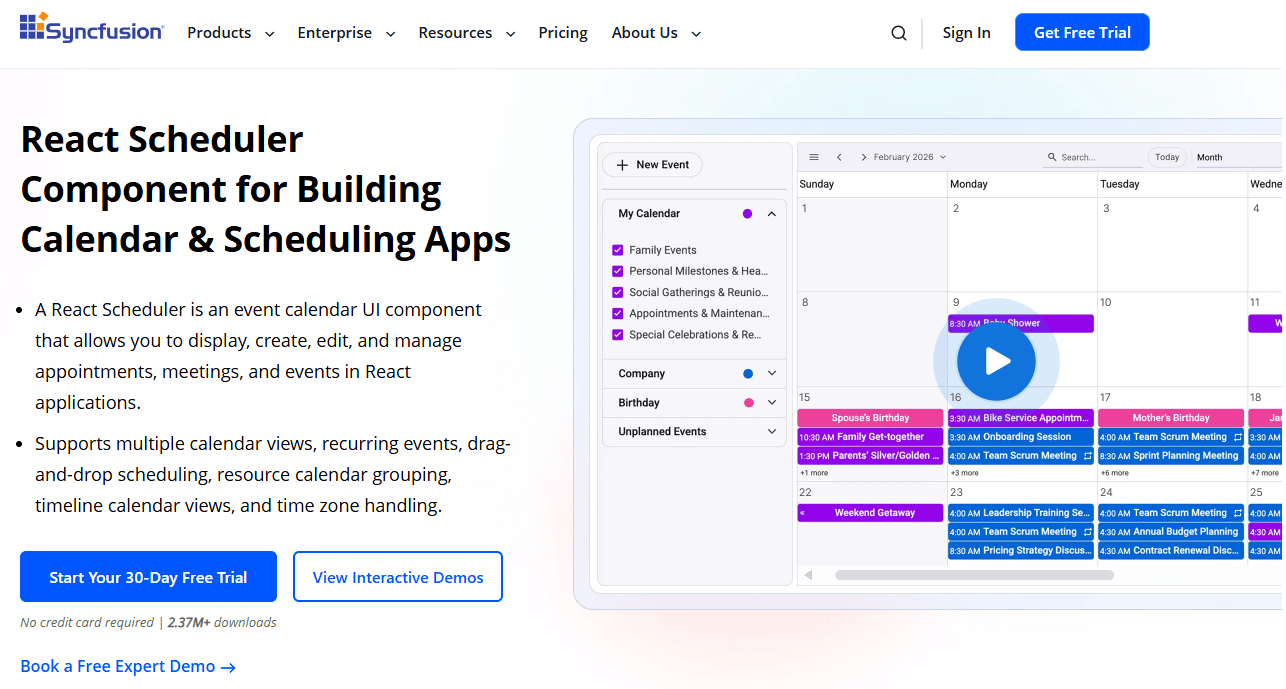
What it is: Syncfusion's React Scheduler is one control inside Essential Studio, a suite of more than sixteen hundred components. That framing is the pitch: if your app also needs grids, charts, pivot tables, and a PDF viewer, buying them together from one vendor on one support contract beats assembling five separate libraries.
Key features:
Per appointment timezones. A global timezone property plus startTimezone and endTimezone on individual appointments, which is more granular than most competitors offer.
Full view range. Day, week, work week, month, year, agenda, and timeline views out of the box.
Virtual scrolling and on demand loading. Data loads lazily by default, so large event sets don't block first paint.
Custom overlap ordering. A sortComparer hook controls how simultaneous events stack, instead of leaving you with the default start time rule.
Cross framework parity. The same scheduler exists for Angular, Vue, Blazor, and .NET MAUI, which helps shops running mixed stacks.
Pricing: Syncfusion offers a free Community License for eligible individual developers and small businesses with less than $1 million in annual revenue, five or fewer developers, and ten or fewer employees. Larger organizations need a commercial license and must reach out to Syncfusion's sales team for custom pricing.
Pros:
The Community License gives qualifying small teams the entire suite at no cost, with no trial clock
Timezone handling is among the most thorough in the category
One vendor and one support contract across every UI control in the app
Unlimited support tickets and bug reports on paid plans
Cons:
Quote only pricing means you can't budget the project before talking to a salesperson
Subscription licensing with no perpetual option means the components stop being usable if you stop paying
Community License eligibility depends on headcount and funding, so a successful round can turn a free dependency into an unplanned purchase
Documentation spread across sixteen hundred components makes finding a specific scheduler answer slower than it should be
Best for: Small companies that qualify for the Community License, and larger teams already standardizing a data heavy application on Essential Studio.
Comparison verdict: If you qualify for the Community License, Syncfusion is arguably the best value in this article. Above that threshold, quote only pricing makes it hard to budget a project before talking to sales. Cal.com's published per user rates let you model the same build in a spreadsheet.
5. KendoReact Scheduler: best React scheduler component library for enterprise design system consistency
Free plan? | Starting price | Standout feature | Best use case |
|---|---|---|---|
Free tier exists, but excludes the Scheduler | $649 per developer per year | Outlook style scheduling inside a polished design system | Enterprise apps that need a consistent look across many components |
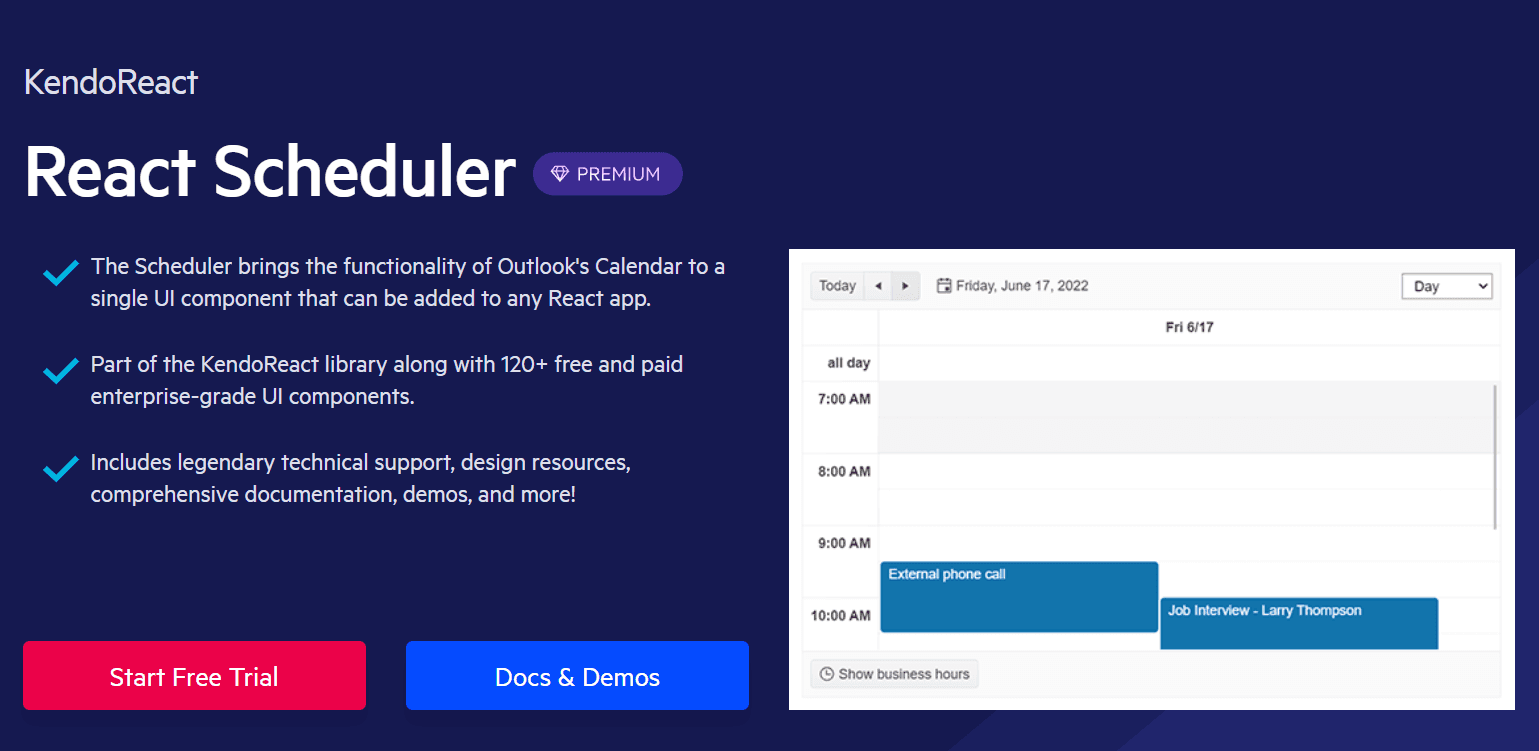
What it is: KendoReact is Progress Telerik's React suite, written in TypeScript and built for React rather than wrapped from an older codebase. The Scheduler brings Outlook style event management into a single component: multiple views, resource grouping, timezone conversion, and a built in recurrence editor that handles daily, weekly, monthly, and yearly patterns without you building the dialog.
Key features:
Built in recurrence editor. The end user dialog for creating repeating events ships with the component, which saves a fiddly build.
Resource grouping and visualization. Events grouped and color coded by resource across day, week, work week, month, timeline, and agenda views.
Four professional themes plus ThemeBuilder. Default, Material, Bootstrap, and Fluent, with a visual tool for producing your own.
Figma UI kits. Designers work in the same component set developers ship, which removes a common source of handoff friction.
AI coding assistant and MCP servers. Tooling trained on the library, aimed at producing usable component code on the first attempt.
Pricing: KendoReact offers a free plan with 50+ React components for production use. The full commercial suite, which includes the Scheduler and 120+ premium components, starts at $649 per developer per year with lite support, $749 with priority support, or $1,199 with phone support.
Pros:
Design system, Figma kits, and components stay in lockstep, so the calendar matches the rest of the app
The recurrence editor alone removes work most teams underestimate
Written in TypeScript with full type definitions and tree shaking support
Support tiers state response times and incident counts clearly, so you know what you bought
Cons:
The free tier misleads teams who assume the Scheduler is included and find the license requirement mid build
Annual per developer renewal makes this a recurring cost rather than a one time one
The suite carries a distinct visual identity that takes effort to neutralize in a strongly branded product
Value depends on using many components, so buying it for the Scheduler alone is poor economics
Best for: Enterprise teams building internal applications with many data components, where visual consistency and a designer to developer pipeline matter more than per seat cost.
Comparison verdict: KendoReact makes sense when the Scheduler is one of twenty components you're licensing anyway, and the recurrence editor is better than most teams would build. As a standalone scheduling purchase the economics are thin, and availability logic is still yours to write. Cal.com's free plan covers a working booking flow before anyone signs a purchase order.
6. DevExtreme React Scheduler: best React scheduler component library for predictable commercial redistribution
Free plan? | Starting price | Standout feature | Best use case |
|---|---|---|---|
No, 30-day day trial | $899.99 per developer per year | Royalty free redistribution with no OEM negotiation | Commercial products that need clear redistribution rights |
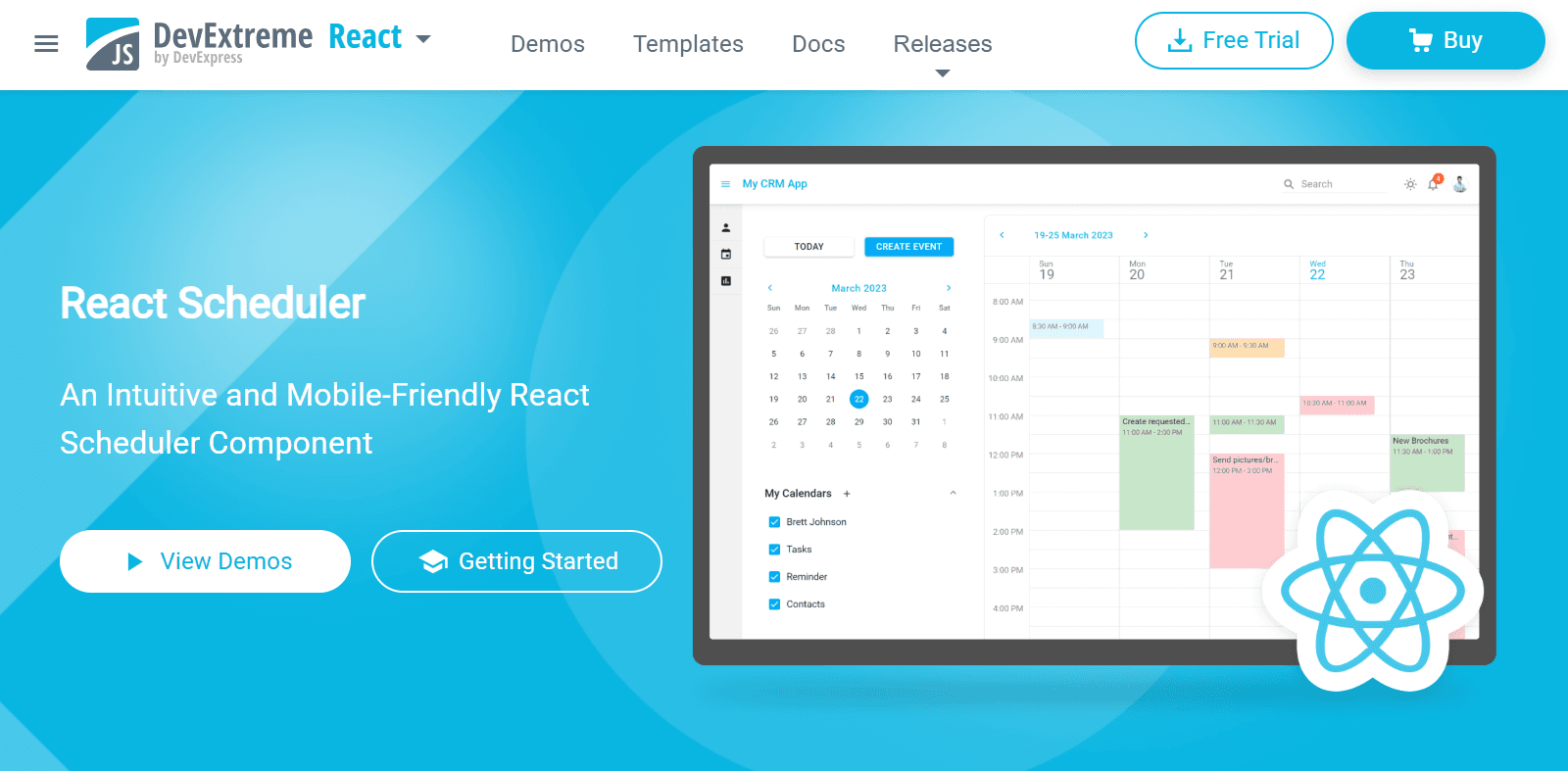
What it is: DevExtreme is DevExpress's JavaScript suite, and its React Scheduler covers the familiar view set with drag and drop event management, configuration forms, and an API for managing recurring event chains. What lifts it above heavier competitors is commercial: once you've bought a subscription, you can ship applications built with it royalty free, with no separate OEM conversation.
Key features:
Recurring event chain API. Programmatic control over series and individual occurrences, not just an end user dialog.
Appointment forms out of the box. Create and edit dialogs ship configured, so the CRUD layer of the calendar isn't a build task.
Full suite included. Eighty plus components across React, Angular, Vue, and jQuery come with the same subscription.
Source code included. DevExtreme Complete is one of the DevExpress subscriptions that ships source.
ThemeBuilder and CLI scaffolding. Visual theming plus project generators, which shortens the first day of a new build.
Pricing: The DevExtreme Complete subscription, which includes the React Scheduler and 80+ JavaScript UI components, starts at $899.99 per developer for a 12-month subscription. The subscription includes product updates, technical support, and royalty-free distribution, with discounted renewal pricing available after the first year.
Pros:
Royalty free redistribution removes the biggest licensing risk in this category
A sixty day refund window is long enough to build something before committing
Renewal at roughly half the initial price makes multi year budgeting straightforward
Keeping the last licensed version after lapsing protects you from a hard cutoff
Cons:
First year cost per developer is the highest published figure in this comparison
Support is web ticket only with no phone or chat channel, which slows escalation during an incident
Older community tutorials point at devextreme-reactive, a separate project, so search results send newcomers down the wrong path
The React components carry design conventions from a suite built for enterprise .NET shops, which takes styling work to shake off
Best for: Teams shipping a commercial product who want redistribution rights settled in the price list rather than in a contract negotiation.
Comparison verdict: DevExtreme has the cleanest commercial terms of any paid library here, which matters if you've been caught by an OEM clause before. It's a UI subscription rather than a scheduling service, so calendar sync, availability rules, and booking state stay on your side. Cal.com covers those and starts free.
7. Mobiscroll: best React scheduler component library for mobile first scheduling interfaces
Free plan? | Starting price | Standout feature | Best use case |
|---|---|---|---|
No, ninety day trial | $995 per project | Per project licensing that doesn't scale with team size | Scheduling apps used mainly on phones and tablets |
What it is: Mobiscroll started as a mobile UI toolkit and its scheduling components inherited that focus. Touch behavior, gesture handling, and small viewport layouts are designed in rather than retrofitted, which shows if your users are field staff on phones. The scheduling family covers event calendar, scheduler, timeline, and agenda views across React, Angular, Vue, jQuery, and plain JavaScript.
Key features:
Mobile first interactions. Drag, resize, and navigation are tuned for touch rather than adapted from a desktop grid.
Timeline view with hierarchical resources. Nested resource groups with work week and hour configuration, suited to rota and shift planning.
Optional calendar integration plugin. Client side Google Calendar and Outlook syncing for loading, reading, and writing events, sold as an add on.
Theme Builder. Platform specific looks or a custom brand theme, generated visually.
Mobiscroll Connect. A separately priced sync service that bridges user calendars into your app if you'd rather not build that layer.
Pricing: Mobiscroll's Scheduling & Calendaring license starts at $995 per project for a perpetual license, which includes one year of updates and standard support. Google Calendar integration and Outlook Calendar integration are available as paid add-ons. If you're building a customer-facing or SaaS application, you'll need a separate commercial license and must contact Mobiscroll's sales team for custom pricing.
Pros:
Per project pricing is the friendliest model here for teams larger than three or four developers
A ninety day trial is long enough to build and demo a real feature before paying
Touch behavior is noticeably better than desktop first competitors on small screens
Perpetual licensing with optional maintenance renewal at a discount
Cons:
The single project restriction means a second product line triggers a second full purchase
Calendar integration and source access are priced separately, so the headline figure understates the real cost
The internal project license excludes multi customer software, so a product company pays subscription rates instead
The suite is smaller than Syncfusion or KendoReact, so it's a poor anchor for teams wanting one vendor across the whole UI
Best for: Teams building scheduling interfaces that live on phones and tablets, particularly field service and rota planning, with more developers than a per seat license would comfortably cover.
Comparison verdict: Mobiscroll is the strongest option here for phone and tablet interfaces, and per project licensing is a relief for larger teams. The license split matters though: as soon as your app serves multiple customers, you're into subscription pricing and a sales conversation. Cal.com publishes per user rates with a free plan underneath, so an embedded product can model its cost up front.
8. DHTMLX Scheduler: best React scheduler component library for perpetual licensing on a fixed budget
Free plan? | Starting price | Standout feature | Best use case |
|---|---|---|---|
Yes, GPL v2.0 Standard Edition only | $599 Individual | Perpetual licenses with clearly published tiers | One off projects with a fixed budget and no recurring spend |
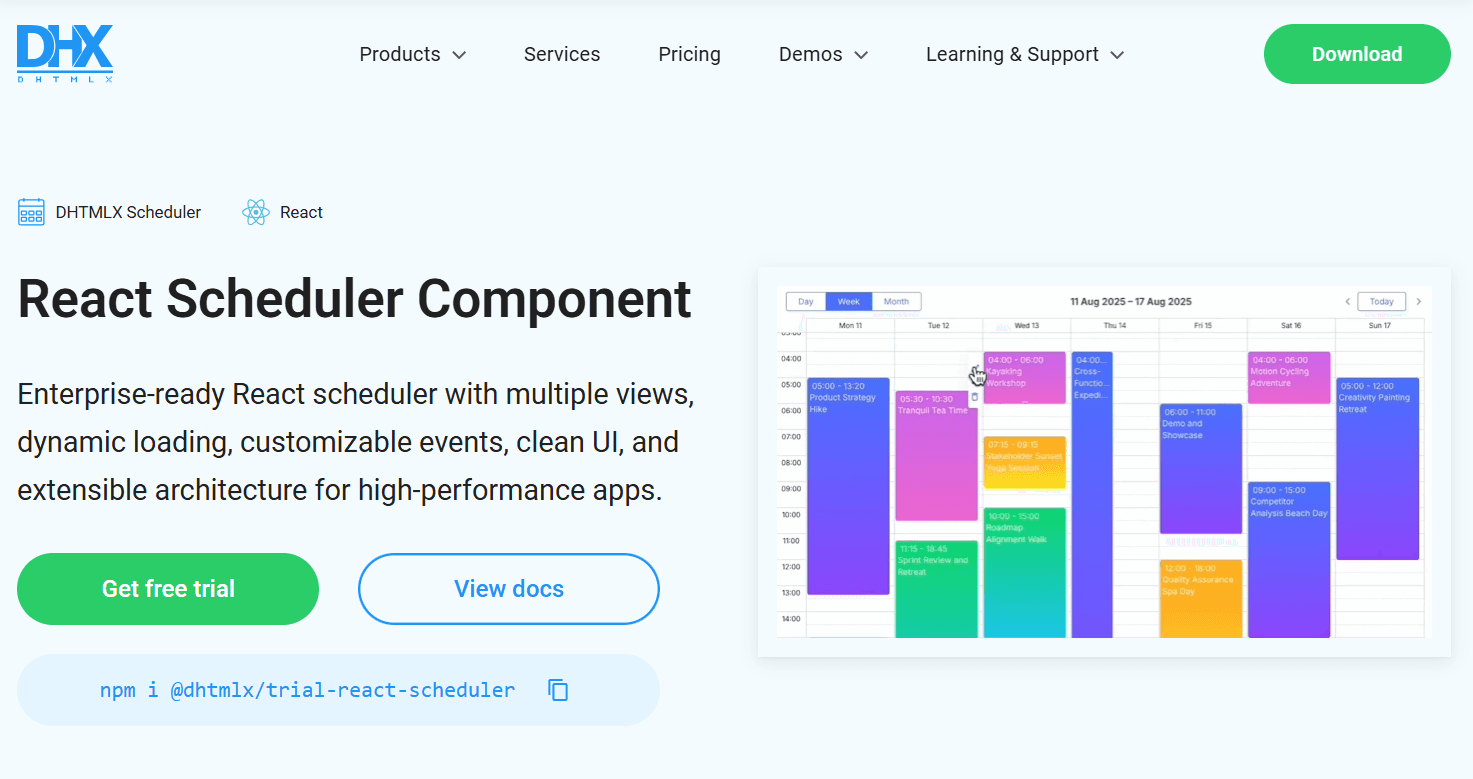
What it is: DHTMLX Scheduler is a long established JavaScript calendar with a broad view set, including Timeline and Units views that arrange resources against a timescale. It integrates with React through documented patterns rather than a first class React package, which is a real difference from newer entrants, but the underlying component is mature and the API is thorough.
Key features:
Timeline and Units views. Events arranged horizontally per resource, or resources along the X axis with time on the Y, which suits staff timetables and room planners.
Built in recurring events. Define a repeat pattern and the component generates and maintains the instances.
Extensive configuration API. Deep control over appearance and behavior through documented methods, properties, and events.
Wide backend integration examples. Documented patterns for Node, PHP, Laravel, Rails, and Salesforce, useful if your stack isn't JavaScript end to end.
Optional booking widget. A separate small component for appointment booking, sold as a low cost add on.
Pricing: DHTMLX Scheduler offers a free Standard edition under the GNU GPL v2 license, which includes core scheduling features like day, week, month, and year views, recurring events, and drag-and-drop editing. Paid PRO licenses start at $599 for one developer and one project, include one year of updates and support, and unlock advanced features such as Timeline and Resource views.
Pros:
Published tiers and perpetual terms make this the easiest paid library here to get through procurement
Pay once and the version you bought keeps working indefinitely
Startup discounts reach 70%, the steepest on this list
Timeline and Units views are included in paid tiers rather than sold separately
Cons:
The GPL v2.0 free edition is a licensing trap for anyone building closed source, and the terms are easy to skim past
React support comes through integration guides rather than a native package, so the component sits outside your normal state flow
Support ticket allowances are capped per tier, so a difficult integration can use them up
The visual defaults look dated next to Material or Fluent based competitors and need real CSS work
Best for: Agencies and internal teams delivering a fixed scope project on a fixed budget, where a one time perpetual license is easier to approve than a recurring subscription.
Comparison verdict: DHTMLX is the straightforward choice when finance wants one invoice and no renewals, and the published tiers make it easy to plan. React support arrives through integration guides rather than a native package, and the free edition's GPL terms rule it out for most commercial products. Cal.com's components are React first and its free tier carries no copyleft obligation.
9. MUI X Scheduler: best React scheduler component library for teams already standardized on Material UI
Free plan? | Starting price | Standout feature | Best use case |
|---|---|---|---|
Yes, MIT licensed Community edition | Per developer, published on the MUI store | Daylight saving aware recurrence in the Premium tier | Products already built on Material UI |
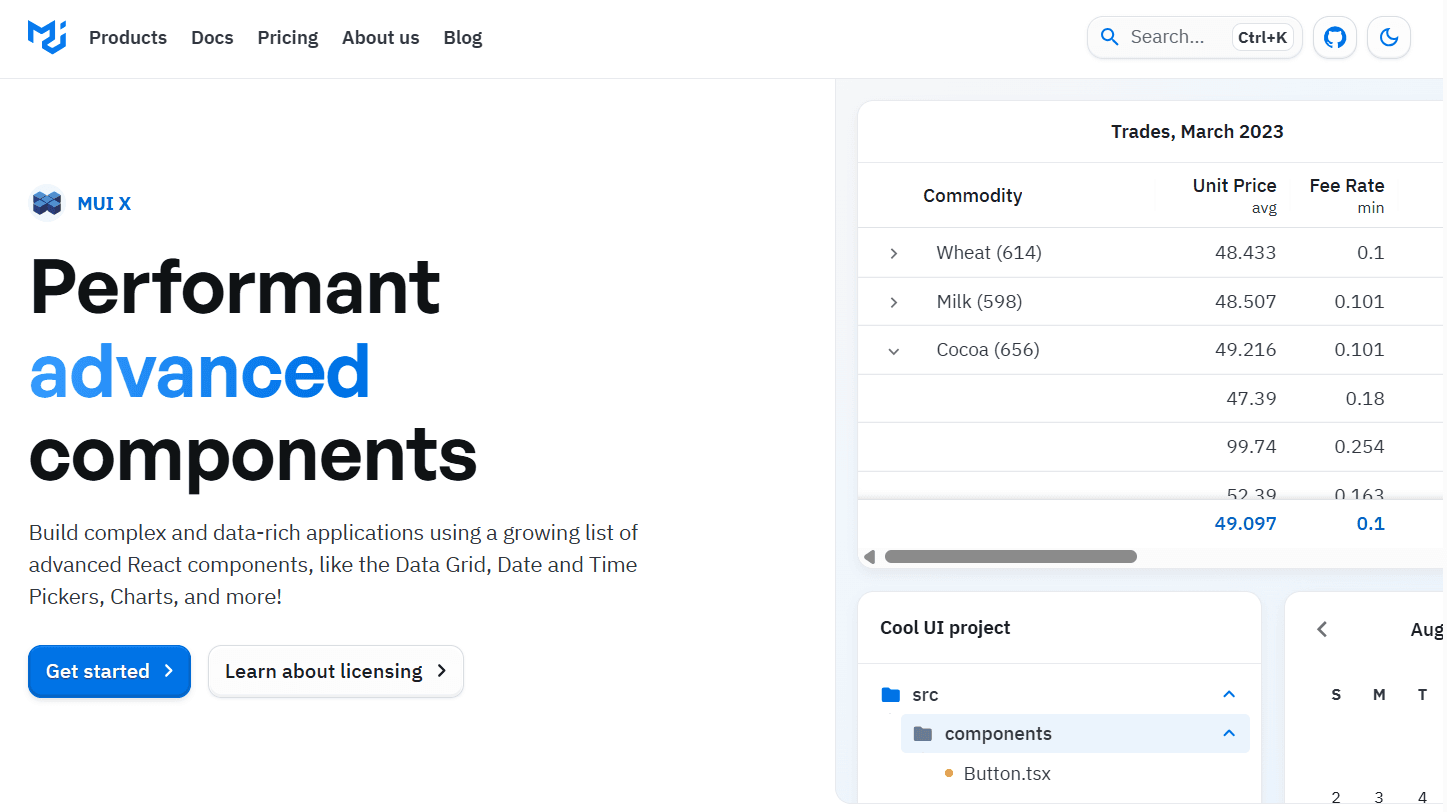
What it is: MUI X is the commercial extension of Material UI, and the Scheduler is its newest addition. The Community Event Calendar is MIT licensed and covers multiple views, resources, drag and drop, resizing, and full theming. Premium adds the parts that usually cause trouble: recurring events, exception dates, daylight saving aware recurrence, lazy loading through data sources, and a horizontal Event Timeline.
Key features:
MIT licensed core with real capability. Views, resources, drag and drop, and theming are all in the free tier rather than teased in it.
Daylight saving aware recurrence. Premium handles clock changes inside a recurring series, which is the failure most teams find in production.
Exception dates. Skip or modify a single occurrence without breaking the series.
Event Timeline included with Premium. A horizontal resource timeline with continuous allocation bars, at no separate purchase.
One line upgrade path. Community and Premium share an API, so moving up doesn't mean rewriting the integration.
Pricing: MUI X Scheduler offers a free Community edition under the MIT license, with core scheduling features. Advanced capabilities, such as recurring events, exception dates, daylight saving time support, lazy loading, and the Event Timeline, require MUI X Premium, which starts at $599 per developer per year. Perpetual licenses are also available.
Pros:
Drops into an existing Material UI application with no visual reconciliation work
The free tier is more capable than most free tiers in this comparison
Daylight saving aware recurrence is handled explicitly rather than left to you
Backed by a team with a long track record maintaining the Data Grid at similar complexity
Cons:
The Scheduler packages are still marked beta, so APIs can change before a stable release
The licensing model counts every front end developer on the project, not just the ones touching the calendar, which inflates seat counts
Material Design conventions are baked in, so a non Material product inherits a look it has to fight
Recent licensing changes mean older pricing guidance you find online is unreliable
Best for: Teams whose product is already Material UI, who want a calendar that matches without theming work and can tolerate a component still stabilizing.
Comparison verdict: For a Material UI codebase this is the natural pick, and the daylight saving handling in Premium is better thought through than several paid competitors. Beta status is the caveat, since APIs can still change under a revenue critical booking flow. Cal.com's components already run production bookings at scale.
10. react-big-calendar: best free React calendar library for straightforward event views
Free plan? | Starting price | Standout feature | Best use case |
|---|---|---|---|
Yes, fully free | $0, MIT licensed | No license, no tiers, no vendor relationship | Internal tools and prototypes with modest requirements |
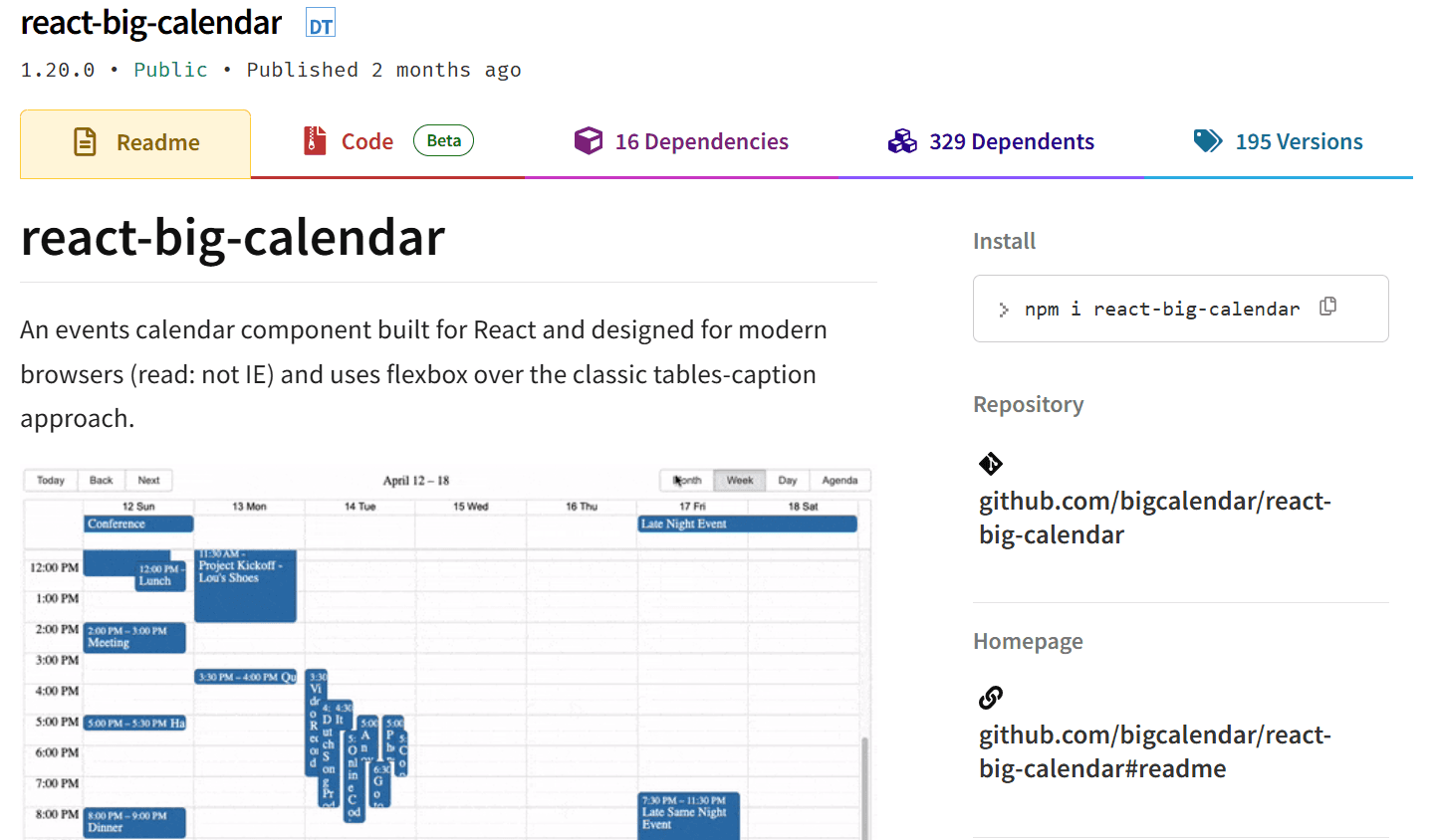
What it is: react-big-calendar is the community's default free answer to the Google Calendar style view. It's MIT licensed with no premium tier and no gated features, built with flexbox rather than the older table layout approach, and it gives you month, week, day, and agenda views with a pluggable localizer so you can use whichever date library you already have.
Key features:
Four localizer options. Moment.js, Globalize.js, date-fns, or Day.js, so it fits the date handling you've already committed to.
Month, week, day, and agenda views. The standard set, with custom view support if you need something else.
Drag and drop addon. Moving and resizing events, available as a separate addon with its own stylesheet.
SASS variables for theming. Color and sizing variables you can override rather than a closed theme system.
Free for commercial use. MIT with no restrictions on revenue, team size, or redistribution.
Pricing: react-big-calendar is free and open source under the MIT License, so you can use it for personal and commercial projects at no cost. There are no paid plans or premium features. But you'll spend time building and maintaining it yourself. For example, drag-and-drop needs manual setup, there's no vendor support, and any features beyond the built-in views are up to your team to build.
Pros:
Zero cost and zero licensing risk regardless of how your business model changes
A large install base means most integration questions already have community answers
Localizer flexibility avoids forcing a second date library into your bundle
No vendor lock in, since you can fork and patch it yourself
Cons:
Drag and drop arrives as an addon you wire up yourself, so the interaction work falls on your team
No resource timeline view, which rules it out for staff and equipment scheduling
Community maintenance means no response time commitment when something blocks a release
The container needs an explicit height or the calendar renders as nothing, a first hour trap that catches almost everyone
Best for: Internal dashboards, prototypes, and side projects that need a competent event calendar and have engineering time to spend instead of budget.
Comparison verdict: react-big-calendar is a good choice for an internal view of events you already own. It draws a calendar and stops there by design, which is right for its audience and wrong for a booking product. If customers are picking slots, Cal.com gives you a free starting point with the availability engine attached.
React scheduler component libraries: quick comparison
Here’s a summary of how the react scheduler component libraries stack up:
Tool | Free plan? | Licensing clarity | Scheduling depth | Integration effort |
|---|---|---|---|---|
Cal.com | ✅ Free forever | ✅ Published per user tiers | ✅ Availability, recurrence, timezones | ✅ Booking engine included |
FullCalendar | ✅ MIT core | ✅ Published, perpetual fallback | ⚠️ Resource views are Premium | ⚠️ You supply availability |
Bryntum | ❌ Trial only | ⚠️ OEM is quote only | ✅ Dependencies and large datasets | ⚠️ Heavy configuration |
Syncfusion | ⚠️ Only if you qualify | ❌ Quote only pricing | ✅ Per appointment timezones | ⚠️ Very large suite to learn |
KendoReact | ⚠️ Excludes the Scheduler | ✅ Published per seat rates | ✅ Recurrence editor included | ⚠️ Design system to absorb |
DevExtreme | ❌ Trial only | ✅ Royalty free redistribution | ⚠️ Solid views, fewer extras | ⚠️ Suite conventions apply |
Mobiscroll | ❌ Trial only | ⚠️ SaaS tier is quote only | ✅ Timeline and mobile depth | ⚠️ Add ons priced separately |
DHTMLX | ⚠️ GPL v2.0 only | ✅ Four published tiers | ✅ Timeline and Units views | ❌ React via integration guides |
MUI X Scheduler | ✅ MIT core | ⚠️ Model recently changed | ⚠️ Strong but still beta | ✅ Fits Material UI directly |
react-big-calendar | ✅ Fully free | ✅ MIT, no conditions | ❌ No resource timeline | ❌ You build the rest |
Final verdict
Most of these libraries render calendars well. What separates them is what happens after you leave the demo. Pricing models vary widely, from free MIT code to per developer subscriptions to OEM contracts with no published rate, so price your real team against your real business model before you commit.
If you're rendering events you already own, choose on ergonomics and license. FullCalendar and react-big-calendar cover most free cases. Bryntum and DHTMLX handle dense resource planning. MUI X or KendoReact make sense when the calendar needs to match an existing design system.
If customers are booking time, the calculation changes. The grid is the visible part of a feature that is mostly availability logic, calendar syncing, conflict handling, timezone correctness, and booking state, and every library above leaves that work to you. Cal.com Atoms gives you React components with all of it already running underneath, which is why it leads this list.
Frequently asked questions
What is the best React scheduler component library? For teams building booking into a product, Cal.com is the strongest pick, because its React components sit on a live availability engine that handles calendar sync, conflict checking, and timezone logic. If you only need to render events you already control, FullCalendar's MIT licensed core is the best free starting point.
How much do React scheduler component libraries cost? The range runs from nothing to several thousand dollars. Free MIT options like react-big-calendar and the FullCalendar and MUI X community tiers cost zero. Paid per developer licenses generally land between $600 and $1,199, though FullCalendar's Premium starts at $480 and covers a team of up to ten. Per project options include Mobiscroll at $995, with multi project bundles reaching $8,955. Cal.com's paid plans start at $16 per user per month, and enterprise and OEM terms across the category are quote only.
Is there a free React scheduler component library I can use commercially? Yes, but check the license rather than the price. react-big-calendar is MIT with no conditions, FullCalendar's Standard edition is MIT, and the MUI X Event Calendar community tier is MIT. Syncfusion's Community License is free only under revenue, headcount, and funding limits. Be careful with the free DHTMLX Standard Edition, which is GPL v2.0 and therefore not usable in closed source commercial software.
Do I still need a backend if I use a React scheduler component? In almost every case, yes. These components render events and capture interactions. They don't store bookings, check a host's real calendar, stop two people claiming the same slot, or send confirmations. You either build that layer or use a scheduling platform that provides it. Cal.com is the option here that ships the React components and the backend together.
Which React scheduler component library is best for resource and timeline scheduling? Bryntum Scheduler, if the schedule is dense and internal. Its virtual rendering holds up under thousands of events, and Scheduler Pro understands dependencies between tasks, which most calendar components have no concept of. DHTMLX and Mobiscroll are strong cheaper alternatives, and if you want something lightweight and free, Schedule-X is worth a look before you buy anything.
Getting started with Cal.com
Cal.com's free plan includes unlimited event types, unlimited calendar connections, and payments on bookings, with no time limit on any of it. Install @calcom/atoms, drop the Booker component into your app, and you can have real bookings landing in real calendars the same afternoon. Teams and Organizations are a plan change away when you need routing or compliance, not a rebuild.
Get started with Cal.com’s free plan and take your first booking today.

Get started with Cal.com for free today!
Experience seamless scheduling and productivity with no hidden fees. Sign up in seconds and start simplifying your scheduling today, no credit card required!