" height="24px" id="WCm44spAV" width="24px"/><path d="M 3.892 7.742 C 1.674 7.742 0 6.014 0 3.882 C 0 1.738 1.589 0 3.892 0 C 5.107 0 5.951 0.374 6.623 1.173 L 5.566 2.09 C 5.118 1.621 4.564 1.386 3.892 1.386 C 2.452 1.386 1.547 2.517 1.547 3.882 C 1.547 5.246 2.452 6.356 3.924 6.356 C 4.649 6.356 5.193 6.111 5.63 5.63 L 6.718 6.558 C 6.153 7.24 5.193 7.742 3.892 7.742 Z" fill="rgb(255, 255, 255)" height="7.741500000000002px" id="XEPpGD7l5" transform="translate(4 8.25)" width="6.717999999999989px"/><path d="M 2.74 7.922 C 1.215 7.922 0 6.632 0 5.032 C 0 3.433 1.215 2.122 2.74 2.122 C 3.7 2.122 4.201 2.516 4.5 3.113 L 4.5 2.239 L 5.928 2.239 L 5.928 7.784 L 4.531 7.784 L 4.531 6.877 C 4.233 7.507 3.731 7.922 2.74 7.922 Z M 1.439 5.023 C 1.439 5.865 2.057 6.622 2.975 6.622 C 3.924 6.622 4.531 5.897 4.531 5.033 C 4.531 4.169 3.924 3.423 2.975 3.423 C 2.057 3.423 1.439 4.159 1.439 5.022 Z M 6.784 7.784 L 6.784 0 L 8.224 0 L 8.224 7.784 L 6.784 7.784 Z" fill="rgb(255, 255, 255)" height="7.9224997406005855px" id="lGDJupIUR" transform="translate(10.5 8)" width="8.223500194549558px"/></g></svg>)
" width="18px"><path d="M 2 8 C 0.895 8 0 7.105 0 6 L 0 2 C 0 0.895 0.895 0 2 0 L 6 0 C 7.105 0 8 0.895 8 2 L 8 6 C 8 7.105 7.105 8 6 8 Z" fill="transparent" height="8px" id="ZrCrI93dV" stroke-dasharray="" stroke-linecap="round" stroke-linejoin="round" stroke-width="2" stroke="rgb(0, 0, 0)" width="8px"/><path d="M 0 0 L 0 4 C 0 5.105 0.895 6 2 6 L 6 6" fill="transparent" height="6px" id="emltWYAiE" stroke-dasharray="" stroke-linecap="round" stroke-linejoin="round" stroke-width="2" stroke="rgb(0, 0, 0)" transform="translate(4 8)" width="6px"/><path d="M 2 8 C 0.895 8 0 7.105 0 6 L 0 2 C 0 0.895 0.895 0 2 0 L 6 0 C 7.105 0 8 0.895 8 2 L 8 6 C 8 7.105 7.105 8 6 8 Z" fill="transparent" height="8px" id="WpBecYDfi" stroke-dasharray="" stroke-linecap="round" stroke-linejoin="round" stroke-width="2" stroke="rgb(0, 0, 0)" transform="translate(10 10)" width="8px"/></g></svg>)


5 Best Headless Booking Systems | Cal.com
Finding a good headless booking system is harder than it should be. Many products have outdated documentation, unclear pricing, or little recent developer activity, making it difficult to know which ones are still worth considering.
It's tempting to build your own scheduling backend instead, until you have to handle calendar conflicts, time zones, daylight saving changes, booking rules, and two people trying to book the same time slot at once.
After comparing the leading options, I found that Cal.com offers the best balance of control, frontend flexibility, ease of implementation, and pricing.
Cal.com gives you full API write access for creating, rescheduling, and canceling bookings, provisioning users, and embedding scheduling with React components through Cal Atoms. You can also get started on the free Platform plan.
To compare these tools, I reviewed each vendor's API documentation and pricing, then cross-checked the findings against G2, Capterra, and developer discussions.
Each platform is evaluated on three criteria:
API write access: Can you create and manage bookings and users through the API, or only read existing data?
Frontend freedom: Can you build your own UI with React components or APIs, or are you limited to hosted widgets?
How pricing scales: Does pricing grow with bookings, API requests, synced accounts, or active resources?
The comparison table near the end brings these criteria together so you can quickly compare the five platforms side by side.
The 5 best headless booking systems at a glance
Cal.com: best headless booking system overall
Cronofy: best for enterprise calendar sync and compliance
Hapio: best for booking resources that don't live on a calendar
Timekit: best for multi-resource retail and marketplace booking
Recal: best for a lightweight calendar-backed build
What is a headless booking system?
A headless booking system is booking infrastructure with no interface attached. It exposes availability, bookings, rescheduling, cancellation, and webhooks as API endpoints, and your application renders everything the user sees. The name borrows from headless CMS: the logic and the data are separated from the presentation, so any frontend can sit on top.
What separates one from another isn't whether it's headless. It's how much of the scheduling problem the service actually solves, and the category splits into three levels.
Raw calendar APIs. The Google Calendar API and Microsoft Graph create and read events on one provider. Availability, conflict handling, and the booking record are all yours.
Calendar connectivity layers. These merge several providers behind one interface and answer free-busy and availability questions. They tell you when someone is free; they don't hold the booking.
Full booking platforms. These own the booking record itself. They hold the rules, reject the double booking, fire the webhook, and keep state consistent when someone reschedules from their phone.
That third level is where most build timelines go wrong, because teams pick a connectivity layer expecting a booking platform. The gap shows up after the demo, when the work that's left turns out to be backend work rather than frontend work. So the first question to ask of any candidate is which of those three levels it belongs to.
What to look for in a headless booking system
Write access, not just read access. Check whether you can create bookings, reschedule them, cancel them, define event types or services, set availability rules, and provision new end users, all through the API. Several well-known scheduling brands publish an API that retrieves links and reports on meetings booked elsewhere. That's a reporting integration, not a headless booking API.
Two-way calendar sync across providers. Your users are on Google, Outlook, and Apple. A booking made in your product should appear on the calendar they already look at, and a conflict on that calendar should close the slot in your product. One-way sync means you reconcile state by hand forever. Check who handles the OAuth flow and token refresh too.
Conflict handling that holds under load. Ask what happens when two requests hit the same slot at once, and whether the rejection comes from the server or from a client-side guess. Buffers, minimum notice, booking windows, and time zone handling all belong to the same question.
Webhooks across the full booking lifecycle. Created, rescheduled, and canceled events drive your reminders, CRM writes, payment capture, and internal workflows. Thin webhook coverage means you poll instead, which costs you requests and latency. Look for signed payloads, since you'll be trusting them.
Components you can restyle. Some platforms ship React components you can drop in and style with your own CSS, which puts a branded scheduler on the page quickly and leaves the API available when you need to go further. Components you can theme are worth more than an iframe you can only recolor.
A billing unit that matches your product. Bookings, API requests, synced accounts, active resources, and seats scale very differently. A marketplace with 500 idle providers and 200 monthly bookings pays wildly different amounts depending on which unit the vendor chose. Work out your cost at ten times current volume before signing.
The 5 best headless booking systems
1. Cal.com: best headless booking system overall
Free plan? | Starting price | Standout feature | Best use case |
|---|---|---|---|
Yes | $16/user/month | Cal Atoms React components on top of a full booking API | Products where users book other users |
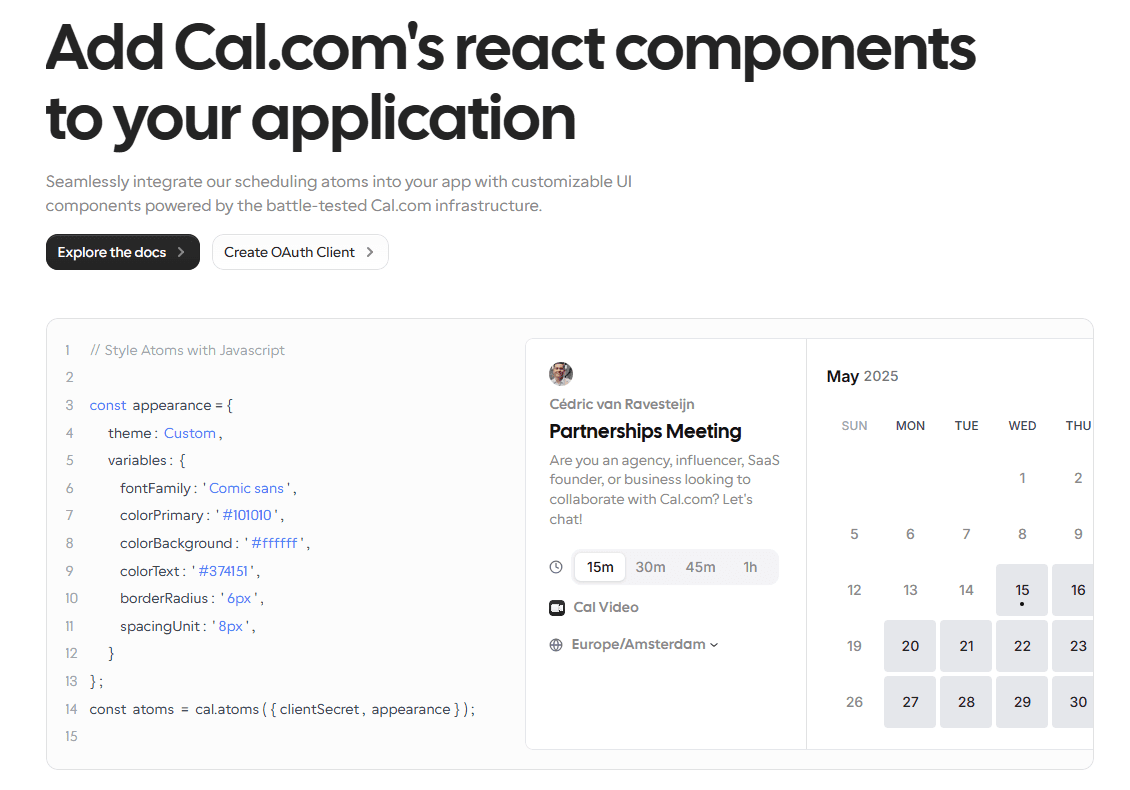
What it is: Cal.com is an API-first scheduling platform built for products that need to add scheduling functionality. You can build a fully custom booking experience using its APIs, embed Cal Atoms React components, or combine both. As your product grows, you can replace the UI with your own components while continuing to use Cal.com's booking infrastructure and APIs.
Why it leads: Cal.com gives developers full control over the booking experience. Even on the free plan, you can create users and event types through the API, connect calendars, and manage bookings without relying on the hosted dashboard. That lets you launch with pre-built components and customize every part of the scheduling experience as your product evolves.
Key features:
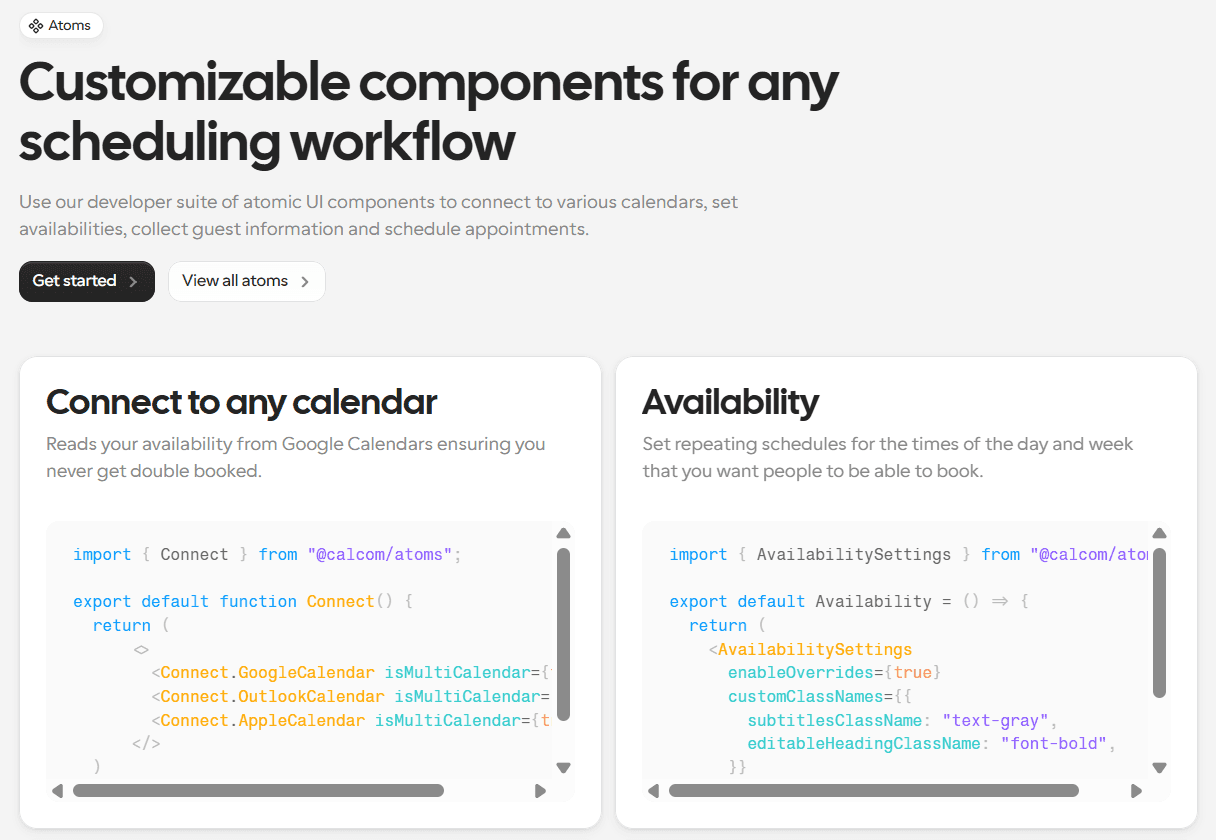
Full booking lifecycle over the API: create, reschedule, and cancel bookings, define event types, and set availability rules programmatically.
Programmatic managed users: provision a scheduling account for each of your end users through the API, which is what makes marketplace and multi-tenant models work.
Cal Atoms React components: booking, availability, event types, calendar connection, and Stripe payments as components for React 18 and 19 and Next.js 14 and 15, styled to match your app.
Two-way calendar sync: Google, Outlook, and Apple, with availability computed across every connected calendar on the account.
Lifecycle webhooks: created, rescheduled, and canceled triggers to drive reminders, CRM writes, payment capture, and your own automation.
Round-robin and team event APIs: distribute bookings across a pool of people programmatically, with attribute-based routing for rules keyed on region, skill, or any custom variable.
Nested organizations: give each of your customers their own space with isolated teams and data, which is the structure you need once your customers have customers.
Stripe payments on bookings: collect payment as part of the booking instead of adding a checkout afterwards.
Full white-label: remove Cal.com branding, run custom domains, and ship the scheduling experience as your own product.
Compliance included: SOC 2, ISO 27001, GDPR, and HIPAA with a signed BAA on the relevant plans, rather than sold as an add-on.
Pricing: Cal.com has a free plan with unlimited event types, calendar connections, and bookings for one user. If you're building a headless booking solution, you'll need the Teams plan, which starts at $16/user/month (monthly billing) and includes API access for extending Cal.com's functionality. Higher-tier plans add features like SSO, advanced security, and enterprise controls.
Best for: Engineering teams building booking into a product where their users meet their users: marketplaces, vertical SaaS, AI agents that need a scheduling backend, and internal platforms that outgrew a calendar API.
Verdict: Cal.com covers the whole booking layer, hands you React components for the parts you'd rather not build, and lets you prove the architecture before spending anything. The billing unit is bookings, which is what your product earns from, and the free Platform tier has no expiry. For a team that wants to own its scheduling experience and keep room to grow, this is the pick.
Get started with cal.com for free or talk to our sales team if you're building at scale or have more complex requirements.
2. Cronofy: best for enterprise calendar sync and compliance
Free plan? | Starting price | Standout feature | Best use case |
|---|---|---|---|
No, developer trial only | $899 per month | Real-time two-way sync with a choice of six data centers | Enterprise products with data residency requirements |
What it is: Cronofy is calendar connectivity infrastructure for product teams that need sync to stay reliable at scale. It connects Google, Microsoft 365, Exchange, and Apple behind one interface, answers single-person, multi-person, and sequenced availability queries, and carries SOC 2, ISO 27001, 27018 and 27701, GDPR, and HIPAA with a BAA on the US service. It also ships an Embedded Scheduler for pre-built UI and an MCP server for agent-driven booking.
Key features:
Real-time two-way sync: across Google, Microsoft 365, Exchange, and Apple, with event triggers and webhook notifications on change.
Deep availability queries: single-person, multi-person, and sequenced availability plus working-hours management, which is genuinely useful for panel interviews.
Choice of six data centers: hold end-user calendar data in the region your customer's legal team requires.
Embedded Scheduler: pre-built scheduling UI elements you can drop into your product when you don't want to build the picker.
Enterprise Connect and meeting rooms: organization-level calendar and conferencing connection on the higher tier, for products selling into large Microsoft and Google estates.
Pricing: There's no free production tier, only a developer trial. The entry API plan is $899 per month and covers up to 1,000 synced accounts. Additional synced accounts cost $0.69 per account per month, so your bill scales with the number of connected users.
Pros:
Sync reliability is the strongest here, with a published 99.99% uptime commitment.
The compliance and data-residency story shortens enterprise security review.
Multi-person and sequenced availability queries handle panel scheduling that other APIs make you assemble.
The MCP server is already shipped if you're building agents.
Cons:
The entry price means you need budget approval before you've shipped anything, which rules it out for prototypes.
You're buying sync and availability, so the booking record, reminders, and payment still live in code you write and maintain.
Reviewers on G2 repeatedly say the developer documentation could be friendlier, and that connecting customer calendars runs into permission issues the guidelines don't cover, so budget time for integration support.
Best for: Enterprise product teams in HR tech, healthcare, and CRM whose main requirement is dependable multi-calendar sync with data residency and compliance, and who have budget to start there.
Comparison verdict (vs Cal.com): If your hard problem is keeping thousands of enterprise calendars in sync across regions, Cronofy is built for exactly that. The difference is scope. With Cal.com the booking is an object the platform manages, and you can validate the full flow on a free tier before committing budget. Cronofy asks for the commitment first and leaves the booking layer to you.
3. Hapio: best for booking resources that don't live on a calendar
Free plan? | Starting price | Standout feature | Best use case |
|---|---|---|---|
Yes | 29 EUR per month per project | Automatic resource allocation across courts, rooms, and equipment | Booking physical assets rather than people's calendars |
What it is: Hapio is a Swedish booking engine designed headless from the start, and it models the problem differently from everything else here. Instead of starting with a person's calendar, it starts with locations, services, and resources, then generates bookable times from the schedules attached to them. That fits when the thing being booked is a tennis court, a treatment room, a piece of equipment, or a class slot.
Key features:
Resource and service modeling: multiple locations in one project with resources and services shared between them, and services that are fixed length, customer-selected length, or booked by the day.
Automatic resource allocation: random, prioritized, or equalized by booked time, so a customer books a service without choosing which court or which therapist.
Generated bookable times: slots computed from service properties and resource schedules, with recurring weekly patterns and one-off blocks combinable.
Buffer time and booking windows: automatic padding before or after each booking, plus control over how far ahead customers can book.
Webhooks and scoped API tokens: event subscriptions plus per-token permissions, so a public-facing client holds a token that can't do anything dangerous.
Pricing: Hapio offers a free plan with 1,000 API requests per month and no expiry. The starter plan costs €29/month per project (~$35 per project) and includes 10,000 requests, with additional requests billed at €0.0029 (~$0.0035) each. Pricing is based on API requests rather than bookings, so costs scale with API usage.
Pros:
Unlimited bookings, resources, services, and locations on every plan, including the free one.
The resource model handles capacity and asset booking directly, which calendar-first APIs make you work around.
The free plan never expires, so development projects can run alongside a paid production project indefinitely.
React UI components and a PHP SDK are both published, which helps teams outside the Node ecosystem.
Cons:
There's no two-way Google or Outlook sync, so if your bookable resources are people with existing calendars, you build and maintain that bridge yourself.
Payments and customer notifications aren't part of the platform, so checkout and reminders become code you own.
Because the meter counts requests rather than bookings, a chatty frontend can push you up a tier without adding a single booking.
Best for: Developers booking physical capacity: sports facilities, studios, rental fleets, salons, and class schedules, where the resource is the asset and nobody's personal calendar needs consulting.
Comparison verdict (vs Cal.com): For pure asset booking with no calendar involved, Hapio is a clean fit and the cheapest credible way in. It's narrower, though. The moment a provider's real Google Calendar has to block a slot, that sync is yours to write. Cal.com covers both shapes, keeps payments and notifications inside the platform, and bills on bookings rather than requests, which is easier to forecast.
4. Timekit: best for multi-resource retail and marketplace booking
Free plan? | Starting price | Standout feature | Best use case |
|---|---|---|---|
No, 14-day trial only | $149 per month for the API tier | A resource graph covering people, rooms, and assets | Retail and marketplace flows with mixed resource types |

What it is: Timekit is a booking API built around a flexible bookable resource, where a resource can be a person, a room, an employee, or an asset, all with synced availability. It has served retail and marketplace customers for a long time, and the feature set shows it: pooled team availability, group and class flows, action links, advanced booking rules, and signed webhooks. It suits booking models that mix staff and physical space in one transaction.
Key features:
Resource graph: people, rooms, employees, and assets modeled as the same bookable primitive, grouped into projects for locations, meeting types, or pools.
Booking and Availability APIs: programmatic slot search and booking creation, with a Resource and Project API on the higher tier for managing the graph itself.
Google and Microsoft calendar sync: real-time availability drawn from the calendars your staff already keep.
Pooled and round-robin assignment: distribute across a team, with group and class booking supported alongside one-to-one.
Signed webhooks and signed search: tamper-evident payloads and queries, which matters when the search runs from an untrusted client.
Pricing: Timekit has no free plan, only a 14-day trial. Pricing starts at $49/month for 3 bookable resources and $15 per additional active resource (that is, resources that took a booking that month). For the Booking and Availability API, you'll need the Professional plan at $149/month, which includes 15 bookable resources and $10 per additional resource.
Pros:
The resource abstraction is the most flexible here for booking people and places together.
Group, class, and pooled availability are supported natively rather than assembled from primitives.
Advanced booking rules and signed search give real control over what a public client can ask for.
A long operating history with recognizable retail and enterprise customers, which helps in a build-versus-buy discussion.
Cons:
The API isn't on the entry plan, so a team budgeting from the advertised $49 finds the real headless price is three times that.
Capterra reviewers note the removal of the free plan made Timekit harder for small businesses to start with, and evaluation now runs against a 14-day clock.
Servers are US-hosted with no published regional choice, so an EU data residency requirement becomes a procurement conversation rather than a setting.
Best for: Retail, services, and marketplace teams booking a mix of staff and physical resources who want a mature resource model and don't need a free tier to start.
Comparison verdict (vs Cal.com): Timekit's resource graph is genuinely good, and for a store network booking staff and fitting rooms together it fits well. The issue for a headless buyer is where the API sits in the price list: $149 per month before the first API call, against a free Platform tier on Cal.com that includes both the API and the React components.
5. Recal: best for a lightweight calendar-backed build
Free plan? | Starting price | Standout feature | Best use case |
|---|---|---|---|
Yes | $49 per month for Growth | A typed Node SDK with an MCP server for agents | Small calendar-backed builds and AI booking agents |
What it is: Recal is a newer headless booking API that puts one interface over Google, Outlook, and iCloud and keeps the surface small. You call it for availability with slot duration, padding, and daily windows as parameters, then call it again to write the event. It's built around a typed Node SDK, ships an MCP server so agents can find time and book directly, and supports nested organizations for multi-tenant calendar management. It also gives you access to your users' OAuth tokens, so moving away later doesn't mean re-authenticating everyone.
Key features:
Unified provider interface: Google, Outlook, and iCloud behind one set of predictable types, with the provider named per call.
Parameterized availability: slot duration, padding, earliest and latest daily times, and time zone passed straight into the scheduling call.
Typed Node SDK: installable in one line, with type definitions covering much of what you'd otherwise read in docs.
MCP server: agent-ready out of the box, a head start if voice or chat booking is on your roadmap.
Token portability: access to your users' calendar tokens, so the integration doesn't become a lock-in mechanism.
Pricing: Recal’s free plan supports 50 calendar connections and 100 bookings a month, which is enough for a real pilot. Growth is $49 per month for 250 connections and 500 bookings. Because connections and bookings meter separately, a product with many connected but rarely booked users hits the connection ceiling first.
Pros:
A typed SDK and a one-line install make it the quickest of these to reach a first availability call.
Token portability is an unusual and concrete commitment to letting you leave.
The free tier is large enough to run a genuine pilot rather than a demo.
MCP support is shipped rather than promised, which suits agent-driven products.
Cons:
The React components are listed as coming rather than available, so today you write the entire booking interface yourself.
Security certification is still shown as in progress on the public site, which stalls review at regulated and enterprise buyers.
There's no payments, reminders, or team-routing layer, so anything past finding a slot and writing the event returns to your roadmap.
Best for: Small teams and solo builders who need calendar-backed booking quickly, and AI product teams who want an MCP-native scheduling backend without a procurement process.
Comparison verdict (vs Cal.com): Recal is easy to start with, and for a lean product that needs slots and events and nothing else it does the job at a friendly price. It's early, and the scope shows it: the components are still on the roadmap, and the booking record, payments, and routing stay yours. Cal.com covers all of that now and provisions end users programmatically, which multi-tenant products need within about a month of launch.
Headless booking systems: quick comparison
By now, you've probably narrowed your shortlist. This table highlights the key differences so you can compare them at a glance before making a decision.
Tool | Free plan? | API write access | Frontend freedom | How the bill scales |
|---|---|---|---|---|
Cal.com | ✅ Platform Starter, 25 bookings a month | ✅ Create, reschedule, cancel, and provision users | ✅ React components plus a fully headless option | ✅ Per booking, from free to enterprise volume |
Cronofy | ❌ Developer trial only | ⚠️ Sync and availability; the booking record is yours | ⚠️ Embedded Scheduler UI elements | ⚠️ Per synced account and seat, from $819 a month |
Hapio | ✅ Build plan, 1,000 requests a month | ✅ Resources, services, and bookings; no calendar sync | ✅ Headless by design, React components published | ⚠️ Per API request and per project, from free |
Timekit | ❌ 14-day trial only | ✅ Booking, availability, and resource APIs | ⚠️ Hosted page and embeddable widget | ⚠️ Per active resource, API from $149 a month |
Recal | ✅ Starter, 100 bookings a month | ⚠️ Availability and events; no booking object | ❌ Components not yet shipped | ✅ Per connection and booking, from free |
Final verdict
A headless booking system should take the expensive parts of scheduling off your roadmap: cross-provider availability, conflict-proof writes, lifecycle webhooks, and token management. Judged that way, these five divide cleanly. Cronofy is sync infrastructure with a compliance story. Hapio is a resource engine for things that were never on a calendar. Timekit is a mature resource graph behind a paywall. Recal is a small, fast, promising start.
Cal.com does the whole job. The booking is an object the platform owns, the API writes as freely as it reads, end users can be provisioned programmatically, and Cal Atoms lets you hand off the interface work you don't want while keeping control of the rest. The billing unit is bookings, the same thing your product monetizes, and the free Platform tier is enough to prove the architecture before anyone approves a budget.
Frequently asked questions
What is the best headless booking system? Cal.com. It's the only option here that gives you write access to the full booking lifecycle (create, reschedule, cancel, provision end users) on a free developer tier, ships React components you can restyle when you don't want to build the interface, and bills per booking rather than per seat or per synced account. That combination of API depth and frontend flexibility is what keeps a build from stalling later.
How much does a headless booking system cost? The category runs from free to a few thousand a month. Free and low-cost entry points include Cal.com Platform Starter (free, 25 bookings), Hapio Build (free, 1,000 requests) and Essential at 29 EUR, and Recal Starter (free, 100 bookings) with Growth at $49. The mid range sits around $149 to $299 a month, and enterprise infrastructure tiers reach $819 to $2,499 and up. What moves your bill is the unit: bookings, API requests, synced accounts, or active resources.
Is there a free headless booking API? Yes, three of the five here have real free tiers rather than trials. Cal.com's Platform Starter is free for 25 bookings a month with full Platform API and Cal Atoms access. Hapio's Build plan is free for 1,000 API requests a month with no expiry. Recal's Starter plan is free for 50 calendar connections and 100 bookings. Cronofy and Timekit offer trials only.
Which headless booking system is best if I only need calendar sync? Cronofy, if your requirement really is sync rather than booking. It's built for real-time two-way sync across Google, Microsoft 365, Exchange, and Apple, offers six data centers for residency requirements, and carries SOC 2, ISO 27001, and HIPAA with a BAA. It starts at $819 a month billed annually, so it suits funded products with enterprise customers rather than early prototypes.
Can a headless booking system book rooms, equipment, or classes instead of people? Yes, though the platforms differ in how directly they handle it. Hapio models locations, services, and resources and allocates them automatically, which suits courts, studios, and rental assets. Timekit treats rooms and assets as the same bookable primitive as people, which works for mixed retail flows. Cal.com handles both people and resource-style booking through its API and adds payments, routing, and calendar sync in the same platform.
Get started with Cal.com
The fastest way to judge a headless booking system is to point your own flow at it and see how far you get. Cal.com's Platform Starter gives you the full API and the React component library at no cost, with 25 bookings a month to work with.

¡Comienza con Cal.com gratis hoy!
Experimenta una programación y productividad sin problemas, sin tarifas ocultas. ¡Regístrate en segundos y comienza a simplificar tu programación hoy, sin necesidad de tarjeta de crédito!