" height="18.016311920580208px" id="GKXyVanMq" stroke-dasharray="0" stroke-linecap="butt" stroke-linejoin="miter" stroke-miterlimit="10" stroke-width="0.5" stroke="rgb(0, 0, 0)" transform="translate(3 3)" width="18px"/></svg>)
"/><stop offset="1" stop-color="rgb(227, 224, 244)"/></linearGradient><linearGradient id="CBS1bzkxF-2031533640-linear-gradient" x1="0.49751243781094523" x2="0.5024875621890548" y1="0" y2="1"><stop offset="0" stop-color="rgb(255, 255, 255)"/><stop offset="1" stop-color="rgb(227, 224, 244)"/></linearGradient><linearGradient id="Jd7AK81w9-2031533640-linear-gradient" x1="0.49751243781094523" x2="0.5024875621890548" y1="0" y2="1"><stop offset="0" stop-color="rgb(255, 255, 255)"/><stop offset="1" stop-color="rgb(227, 224, 244)"/></linearGradient></defs><g d="M 0 16 L 0 0 L 16 0 L 16 16 Z M 9.167 5.167 C 9.167 4.891 8.943 4.667 8.667 4.667 C 8.391 4.667 8.167 4.891 8.167 5.167 C 8.167 6.784 7.809 7.834 7.155 8.488 C 6.501 9.143 5.451 9.5 3.833 9.5 C 3.557 9.5 3.333 9.724 3.333 10 C 3.333 10.276 3.557 10.5 3.833 10.5 C 5.451 10.5 6.501 10.857 7.155 11.512 C 7.809 12.166 8.167 13.216 8.167 14.833 C 8.167 15.109 8.391 15.333 8.667 15.333 C 8.943 15.333 9.167 15.109 9.167 14.833 C 9.167 13.216 9.524 12.166 10.178 11.512 C 10.832 10.857 11.883 10.5 13.5 10.5 C 13.776 10.5 14 10.276 14 10 C 14 9.724 13.776 9.5 13.5 9.5 C 11.883 9.5 10.832 9.143 10.178 8.488 C 9.524 7.834 9.167 6.784 9.167 5.167 Z M 4 3.667 C 4 3.483 3.851 3.333 3.667 3.333 C 3.483 3.333 3.333 3.483 3.333 3.667 C 3.333 4.32 3.189 4.715 2.952 4.952 C 2.715 5.189 2.32 5.333 1.667 5.333 C 1.483 5.333 1.333 5.483 1.333 5.667 C 1.333 5.851 1.483 6 1.667 6 C 2.32 6 2.715 6.145 2.952 6.382 C 3.189 6.618 3.333 7.013 3.333 7.667 C 3.333 7.851 3.483 8 3.667 8 C 3.851 8 4 7.851 4 7.667 C 4 7.013 4.145 6.618 4.382 6.382 C 4.618 6.145 5.013 6 5.667 6 C 5.851 6 6 5.851 6 5.667 C 6 5.483 5.851 5.333 5.667 5.333 C 5.013 5.333 4.618 5.189 4.382 4.952 C 4.145 4.715 4 4.32 4 3.667 Z M 7.333 1 C 7.333 0.816 7.184 0.667 7 0.667 C 6.816 0.667 6.667 0.816 6.667 1 C 6.667 1.422 6.573 1.65 6.445 1.778 C 6.317 1.906 6.089 2 5.667 2 C 5.483 2 5.333 2.149 5.333 2.333 C 5.333 2.517 5.483 2.667 5.667 2.667 C 6.089 2.667 6.317 2.761 6.445 2.889 C 6.573 3.016 6.667 3.244 6.667 3.667 C 6.667 3.851 6.816 4 7 4 C 7.184 4 7.333 3.851 7.333 3.667 C 7.333 3.244 7.427 3.016 7.555 2.889 C 7.683 2.761 7.911 2.667 8.333 2.667 C 8.517 2.667 8.667 2.517 8.667 2.333 C 8.667 2.149 8.517 2 8.333 2 C 7.911 2 7.683 1.906 7.555 1.778 C 7.427 1.65 7.333 1.422 7.333 1 Z" fill="transparent" height="16px" id="aoZYv33vR" width="16px"><path d="M 0 16 L 0 0 L 16 0 L 16 16 Z" fill="transparent" height="16px" id="Z2uGmhW9f" width="16px"/><g d="M 7.833 4.5 C 7.833 4.224 7.609 4 7.333 4 C 7.057 4 6.833 4.224 6.833 4.5 C 6.833 6.117 6.476 7.168 5.822 7.822 C 5.168 8.476 4.117 8.833 2.5 8.833 C 2.224 8.833 2 9.057 2 9.333 C 2 9.61 2.224 9.833 2.5 9.833 C 4.117 9.833 5.168 10.191 5.822 10.845 C 6.476 11.499 6.833 12.549 6.833 14.167 C 6.833 14.443 7.057 14.667 7.333 14.667 C 7.609 14.667 7.833 14.443 7.833 14.167 C 7.833 12.549 8.191 11.499 8.845 10.845 C 9.499 10.191 10.549 9.833 12.167 9.833 C 12.443 9.833 12.667 9.61 12.667 9.333 C 12.667 9.057 12.443 8.833 12.167 8.833 C 10.549 8.833 9.499 8.476 8.845 7.822 C 8.191 7.168 7.833 6.117 7.833 4.5 Z M 2.667 3 C 2.667 2.816 2.517 2.667 2.333 2.667 C 2.149 2.667 2 2.816 2 3 C 2 3.654 1.855 4.048 1.618 4.285 C 1.382 4.522 0.987 4.667 0.333 4.667 C 0.149 4.667 0 4.816 0 5 C 0 5.184 0.149 5.333 0.333 5.333 C 0.987 5.333 1.382 5.478 1.618 5.715 C 1.855 5.952 2 6.346 2 7 C 2 7.184 2.149 7.333 2.333 7.333 C 2.517 7.333 2.667 7.184 2.667 7 C 2.667 6.346 2.811 5.952 3.048 5.715 C 3.285 5.478 3.68 5.333 4.333 5.333 C 4.517 5.333 4.667 5.184 4.667 5 C 4.667 4.816 4.517 4.667 4.333 4.667 C 3.68 4.667 3.285 4.522 3.048 4.285 C 2.811 4.048 2.667 3.654 2.667 3 Z M 6 0.333 C 6 0.149 5.851 0 5.667 0 C 5.483 0 5.333 0.149 5.333 0.333 C 5.333 0.756 5.239 0.984 5.112 1.112 C 4.984 1.239 4.756 1.333 4.333 1.333 C 4.149 1.333 4 1.483 4 1.667 C 4 1.851 4.149 2 4.333 2 C 4.756 2 4.984 2.094 5.112 2.222 C 5.239 2.35 5.333 2.578 5.333 3 C 5.333 3.184 5.483 3.333 5.667 3.333 C 5.851 3.333 6 3.184 6 3 C 6 2.578 6.094 2.35 6.222 2.222 C 6.35 2.094 6.578 2 7 2 C 7.184 2 7.333 1.851 7.333 1.667 C 7.333 1.483 7.184 1.333 7 1.333 C 6.578 1.333 6.35 1.239 6.222 1.112 C 6.094 0.984 6 0.756 6 0.333 Z" fill="transparent" height="14.66671286102295px" id="ae6ccdFme" transform="translate(1.333 0.667)" width="12.66663px"><path d="M 5.833 0.5 C 5.833 0.224 5.609 0 5.333 0 C 5.057 0 4.833 0.224 4.833 0.5 C 4.833 2.117 4.476 3.168 3.822 3.822 C 3.168 4.476 2.117 4.833 0.5 4.833 C 0.224 4.833 0 5.057 0 5.333 C 0 5.61 0.224 5.833 0.5 5.833 C 2.117 5.833 3.168 6.191 3.822 6.845 C 4.476 7.499 4.833 8.549 4.833 10.167 C 4.833 10.443 5.057 10.667 5.333 10.667 C 5.609 10.667 5.833 10.443 5.833 10.167 C 5.833 8.549 6.191 7.499 6.845 6.845 C 7.499 6.191 8.549 5.833 10.167 5.833 C 10.443 5.833 10.667 5.61 10.667 5.333 C 10.667 5.057 10.443 4.833 10.167 4.833 C 8.549 4.833 7.499 4.476 6.845 3.822 C 6.191 3.168 5.833 2.117 5.833 0.5 Z" fill="url(%23t2lXByE48-2031533640-linear-gradient)" height="10.66671px" id="t2lXByE48" transform="translate(2 4)" width="10.66663px"/><path d="M 2.667 0.333 C 2.667 0.149 2.517 0 2.333 0 C 2.149 0 2 0.149 2 0.333 C 2 0.987 1.855 1.382 1.618 1.618 C 1.382 1.855 0.987 2 0.333 2 C 0.149 2 0 2.149 0 2.333 C 0 2.517 0.149 2.667 0.333 2.667 C 0.987 2.667 1.382 2.811 1.618 3.048 C 1.855 3.285 2 3.68 2 4.333 C 2 4.517 2.149 4.667 2.333 4.667 C 2.517 4.667 2.667 4.517 2.667 4.333 C 2.667 3.68 2.811 3.285 3.048 3.048 C 3.285 2.811 3.68 2.667 4.333 2.667 C 4.517 2.667 4.667 2.517 4.667 2.333 C 4.667 2.149 4.517 2 4.333 2 C 3.68 2 3.285 1.855 3.048 1.618 C 2.811 1.382 2.667 0.987 2.667 0.333 Z" fill="url(%23CBS1bzkxF-2031533640-linear-gradient)" height="4.66667px" id="CBS1bzkxF" transform="translate(0 2.667)" width="4.66667px"/><path d="M 2 0.333 C 2 0.149 1.851 0 1.667 0 C 1.483 0 1.333 0.149 1.333 0.333 C 1.333 0.756 1.239 0.984 1.112 1.112 C 0.984 1.239 0.756 1.333 0.333 1.333 C 0.149 1.333 0 1.483 0 1.667 C 0 1.851 0.149 2 0.333 2 C 0.756 2 0.984 2.094 1.112 2.222 C 1.239 2.35 1.333 2.578 1.333 3 C 1.333 3.184 1.483 3.333 1.667 3.333 C 1.851 3.333 2 3.184 2 3 C 2 2.578 2.094 2.35 2.222 2.222 C 2.35 2.094 2.578 2 3 2 C 3.184 2 3.333 1.851 3.333 1.667 C 3.333 1.483 3.184 1.333 3 1.333 C 2.578 1.333 2.35 1.239 2.222 1.112 C 2.094 0.984 2 0.756 2 0.333 Z" fill="url(%23Jd7AK81w9-2031533640-linear-gradient)" height="3.333333px" id="Jd7AK81w9" transform="translate(4 0)" width="3.3333399999999997px"/></g></g></svg>)
" height="24px" id="WCm44spAV" width="24px"/><path d="M 3.892 7.742 C 1.674 7.742 0 6.014 0 3.882 C 0 1.738 1.589 0 3.892 0 C 5.107 0 5.951 0.374 6.623 1.173 L 5.566 2.09 C 5.118 1.621 4.564 1.386 3.892 1.386 C 2.452 1.386 1.547 2.517 1.547 3.882 C 1.547 5.246 2.452 6.356 3.924 6.356 C 4.649 6.356 5.193 6.111 5.63 5.63 L 6.718 6.558 C 6.153 7.24 5.193 7.742 3.892 7.742 Z" fill="rgb(255, 255, 255)" height="7.741500000000002px" id="XEPpGD7l5" transform="translate(4 8.25)" width="6.717999999999989px"/><path d="M 2.74 7.922 C 1.215 7.922 0 6.632 0 5.032 C 0 3.433 1.215 2.122 2.74 2.122 C 3.7 2.122 4.201 2.516 4.5 3.113 L 4.5 2.239 L 5.928 2.239 L 5.928 7.784 L 4.531 7.784 L 4.531 6.877 C 4.233 7.507 3.731 7.922 2.74 7.922 Z M 1.439 5.023 C 1.439 5.865 2.057 6.622 2.975 6.622 C 3.924 6.622 4.531 5.897 4.531 5.033 C 4.531 4.169 3.924 3.423 2.975 3.423 C 2.057 3.423 1.439 4.159 1.439 5.022 Z M 6.784 7.784 L 6.784 0 L 8.224 0 L 8.224 7.784 L 6.784 7.784 Z" fill="rgb(255, 255, 255)" height="7.9224997406005855px" id="lGDJupIUR" transform="translate(10.5 8)" width="8.223500194549558px"/></g></svg>)
" width="18px"><path d="M 2 8 C 0.895 8 0 7.105 0 6 L 0 2 C 0 0.895 0.895 0 2 0 L 6 0 C 7.105 0 8 0.895 8 2 L 8 6 C 8 7.105 7.105 8 6 8 Z" fill="transparent" height="8px" id="ZrCrI93dV" stroke-dasharray="" stroke-linecap="round" stroke-linejoin="round" stroke-width="2" stroke="rgb(0, 0, 0)" width="8px"/><path d="M 0 0 L 0 4 C 0 5.105 0.895 6 2 6 L 6 6" fill="transparent" height="6px" id="emltWYAiE" stroke-dasharray="" stroke-linecap="round" stroke-linejoin="round" stroke-width="2" stroke="rgb(0, 0, 0)" transform="translate(4 8)" width="6px"/><path d="M 2 8 C 0.895 8 0 7.105 0 6 L 0 2 C 0 0.895 0.895 0 2 0 L 6 0 C 7.105 0 8 0.895 8 2 L 8 6 C 8 7.105 7.105 8 6 8 Z" fill="transparent" height="8px" id="WpBecYDfi" stroke-dasharray="" stroke-linecap="round" stroke-linejoin="round" stroke-width="2" stroke="rgb(0, 0, 0)" transform="translate(10 10)" width="8px"/></g></svg>)


Microsoft Teams Calendar: How to Schedule Meetings and Fix What's Not Working
4:52 PM on a Tuesday, and a reply finally lands: "Wednesday works, but only after 3."
It's the fourth email in that thread, and the candidate still hasn't confirmed a time anyone can actually put on a calendar.
Modern collaboration tools like Microsoft Teams Calendar have automated almost everything happening within a company's walls. Standups land automatically, project syncs show up where they belong, and everyone inside your company sees exactly who's free and when. The moment someone outside those walls needs a slot, that automation stops, and email takes over again.
Below, you'll find the exact steps for scheduling, channel calendars, recurring meetings, and calendar sync inside Teams itself. You'll also find one section that support.microsoft.com skips entirely, covering how to let clients, candidates, or vendors book time on your calendar without adding them as guests in your directory. And because Microsoft Bookings is the first tool most Teams users try for that job, we've added what it actually costs after Microsoft's July 2026 price change.
Contents
What Is Microsoft Teams Calendar?
Is the Teams Calendar the Same as Your Outlook Calendar?
What Features Matter for Teams Calendar Scheduling?
Where Is the Calendar in Microsoft Teams?
How Do You Schedule a Meeting in the Microsoft Teams Calendar?
How Do You Create a Calendar in Teams for Your Channel?
How Do You Create a Recurring Meeting in Teams?
How Do You Invite External Guests to a Teams Meeting?
How Do You See Someone's Availability With Scheduling Assistant?
Who Can See Your Teams Calendar, and How Do You Share It?
Why Isn't Your Teams Calendar Working or Showing Up?
How Do You Let External People Self-Book Time on Your Calendar?
How Much Does Microsoft Bookings Cost?
Native Teams Calendar vs. a Booking Tool
FAQ
What Is Microsoft Teams Calendar?
Microsoft Teams Calendar is the built-in scheduling tool inside Teams, tied directly to your Outlook and Exchange Online mailbox. Every meeting shows up in one place, no matter if you booked it from Teams or from Outlook, because both apps read the same underlying data. Teams calendar exists for internal scheduling first. It handles standups, project syncs, one-on-ones, and anything else involving people already inside your organization.
Behind the scenes, it shows your colleagues' free and busy time so you can spot a conflict before you send the invite, detects each attendee's time zone automatically, and generates a real meeting link when you save a meeting with the Teams meeting toggle on. None of this reaches outside your company on its own, a limit this guide covers in detail further down.
Is the Teams Calendar the Same as Your Outlook Calendar?
Yes. The Teams calendar and your Outlook calendar are the same calendar, read from the same Exchange Online mailbox. Nothing needs integrating. A meeting you create in Outlook shows up in Teams, and a meeting you create in Teams shows up in Outlook, including its Teams join link.
The differences are in what each app adds around the calendar. Teams adds channel meetings and channel calendars, which Outlook can't show. Most people schedule in whichever app they have open, because the result is identical.

What Features Matter for Teams Calendar Scheduling?
A useful Teams scheduling setup should make availability clear, handle bookings automatically, and connect smoothly with the tools you already use. Whether you rely on native Teams, add Microsoft Bookings, or use a dedicated scheduling tool, look for these core features.
Two-way calendar sync: The scheduler checks your real calendar for conflicts and updates availability as your schedule changes. You avoid double bookings and keep your open slots accurate.
External availability sharing without guest access: People outside your organization can view your availability and book time without joining your directory or becoming a guest.
Automatic meeting links: Each booking automatically creates a working Teams meeting link, removing the need for manual setup after someone books.
Timezone handling: The scheduler detects each participant's timezone and displays the correct meeting time. No one has to calculate time differences before joining a call.
Automated reminders: Email or SMS reminders prompt attendees before their appointments and help reduce no-shows, especially for meetings booked weeks in advance.
Routing and qualification: A booking flow can ask a quick qualifying question and direct each request to the right person or team. This way, your team spends less time sorting incoming appointments.
A public booking page: One shareable link lets clients, candidates, or vendors choose an available time themselves. You can replace long email threads with a simple booking flow.
Integration with your existing tools: Look for direct connections with Outlook, Microsoft 365, Salesforce, Zoom, and other tools your team already relies on. A scheduling system should fit into your workflow and keep your calendar and customer data connected.
Where Is the Calendar in Microsoft Teams?
You'll find the Microsoft Teams calendar on the left side of Teams. Select Calendar to open your schedule and view your work week by default.

The Teams calendar opens in Work week view. New meeting sits in the top-right corner, next to Meet now and Join with an ID.
If you don't see it, select the "…" (More apps) icon at the bottom of the left rail, then pin Calendar to your app list. Once you pin it, meetings you accept in Outlook appear in Teams within moments, while meetings you schedule in Teams appear in Outlook. Both apps use the same calendar data.
To change the view, select the current view name at the top of the calendar and pick Day, Work week, Week, or Month. To change how the calendar looks and behaves, select More options > Calendar settings.
Where Is the Calendar in the Teams Mobile App?
In the Teams mobile app on iOS and Android, tap Calendar in the bar at the bottom of the screen. The mobile calendar opens in agenda view, a scrolling list of your upcoming meetings. Channel calendars don't appear in the mobile app, so open those on desktop or the web.
If your Microsoft Teams calendar stops syncing with Outlook, use the sync fixes below to troubleshoot the issue.
How Do You Schedule a Meeting in the Microsoft Teams Calendar?
To schedule a meeting in the Microsoft Teams Calendar, open Calendar, select New, add your attendees and a time, turn on the Teams meeting toggle, and save. If you're searching for how to schedule a meeting in Microsoft Teams for the first time, these steps match Microsoft's instructions and take you from a blank calendar to a ready-to-join meeting.
Open the Calendar tab in Teams and select New, or select an open timeslot directly in your calendar.
Add a title people will recognize immediately in their inbox.
Add required attendees in the Required attendees field, and add optional attendees separately through Response options if you're using the new calendar.
Set a start and end time, or attach the meeting to a channel if the entire team needs the invite.
If you want to see everyone's time zones and availability first, open Scheduler in the meeting details before locking in a slot. It's optional, and most quick internal meetings skip it entirely.
Turn on the Teams meeting toggle if you want this to be a virtual meeting, then select Save.
Using the free version of Teams? The New meeting window there is simpler. It has no Teams meeting toggle or Scheduler, and a banner shows your plan's limits: up to 60 minutes per meeting with up to 100 participants.
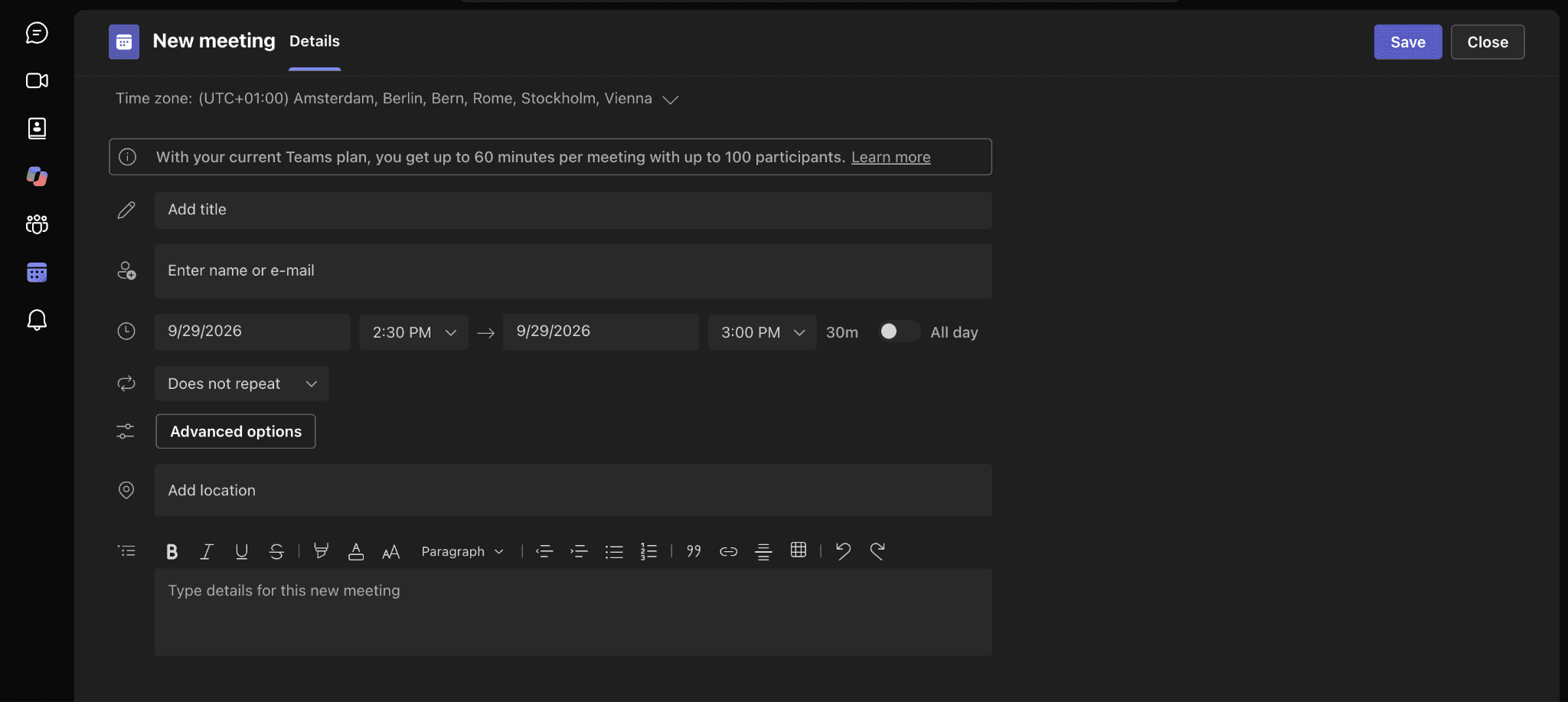
The New meeting window in the free version of Teams, with its plan limits shown at the top.
People miss that toggle all the time. If you leave it off, Teams saves the meeting as an in-person or placeholder event without a join link. If you turn it on before saving, Teams generates a meeting link and adds it to the invite. Once you know how to schedule a meeting in Microsoft Teams, adding a channel calendar or a recurring series takes just as much effort.
How Do You Create a Calendar in Teams for Your Channel?
Channel calendars don't come built in. You'll need to add a calendar to a Teams channel manually through the Channel Calendar app, and Microsoft currently limits channel calendars to standard channels. Private channels don't support them.
Open Microsoft Teams and go to the team and channel where you want the calendar.
Select the + or Add a tab button at the top of the channel.
Select Apps, then search for Channel calendar.
Select Channel calendar from the search results.
Name your new calendar something your team will recognize, such as "Team Calendar" or the project name.
Select Save to finish.
Once you add the calendar, anyone in the channel can create events, and everyone can view the same schedule without dealing with separate invites. If you came here searching for how to add a calendar to a Teams channel, the Channel Calendar app gives you the setup you need. No other setting or workaround provides a channel calendar.
What's the Difference Between a Channel Calendar and a Group Calendar?
Every team in Microsoft Teams has a Microsoft 365 group behind it, and that group has one shared calendar. A channel calendar is a filtered view of that group calendar. It shows only the events scheduled for that one channel, and you can see and schedule channel events only in Teams. The group calendar shows everything for the whole team, and it's the one you'll find under Groups in Outlook.
If you want a team-wide calendar your colleagues can open in Outlook, use the group calendar. If you want one channel's meetings in one place inside Teams, use the channel calendar.
The catch comes down to scope. A Microsoft Teams channel calendar reaches people already in the specific channel. It doesn't reach clients, candidates, or people outside your tenant, which creates the gap the self-booking section below covers. You'll also need to repeat these steps when you want to add calendar to Teams channel setups for new project teams.
How Do You Create a Recurring Meeting in Teams?
To create a recurring meeting in Teams, set any meeting to repeat through the Does not repeat dropdown in the New meeting window. Teams lets you choose Daily, Weekly, Monthly, Yearly, or a Custom pattern.
Open Microsoft Teams on your desktop or web browser, select Calendar on the left, then select New meeting in the upper-right corner.
Add the basic meeting details, including the title, required attendees, start date, and start and end times for the first session.
Open the Does not repeat dropdown below the date and time fields, then choose how often you want the meeting to repeat. You can select Daily, Weekly, Monthly, Yearly, or Custom.
If you choose Custom, set a specific interval, such as every three days, or select specific days of the week. Set an end date, or let the meeting repeat indefinitely.
Add any extra details, such as an agenda or a channel for a group channel meeting.
Select Save or Send to send invitations to your participants.
For a one-on-one or team meeting, Teams creates a normal recurring series, and each attendee receives the meeting on their calendar. A Microsoft Teams channel calendar behaves differently once meetings start repeating. Recurring events only reach the calendars of people who joined the channel before the series began.
Someone who joins the channel two months later can see the channel and its chat history, but the recurring series never automatically reaches their personal calendar. Add a new hire to the invite directly when they need the standing meeting. Relying on channel membership alone can lead to quiet no-shows nobody can explain.
If several people joined since the series started, there's a faster fix that Microsoft's own support answers describe. Open the series, make a small edit, undo it, and select Send update. Teams then re-sends the series, and it lands on the new members' calendars.
How Do You Invite External Guests to a Teams Meeting?
To invite someone from outside your organization to a single meeting, type their email address in the Required attendees field, the same way you'd add a colleague. They get a normal invite with a join link and don't need a Teams account in your organization. Microsoft calls this external access, and your admin controls who can join.
Guest access is a different, bigger step. When you need to collaborate with someone outside your organization in Teams, a team owner can add them as a guest. Guests have fewer capabilities than team members, but they can still participate in the team and access its shared content.
Your admin controls guest access in Teams. If you can't add someone, ask your Microsoft 365 admin to check the guest access settings, as Microsoft's guest access documentation confirms.
To add a guest to your team, follow these steps.
Hover over the team name and select More options > Add member.
Enter the guest's email address. Teams accepts business and consumer email accounts, including Outlook and Gmail. Select the email address again to confirm.
If Teams shows Add (name) as a guest?, select it and add the guest's name.
Select Add to send the welcome email invitation.
Guests from outside your organization receive an email invitation with information about joining Teams and the guest experience. They must accept the invitation before they can access the team, and access can take a few hours after you add them.
Guests also need to sign in to Teams with their guest account. If they normally use Teams with another Microsoft 365 organization, they can switch organizations through their profile picture and select the team or guest account connected to your organization.
You can identify guests by the Guest label beside their name. Team owners can also view member roles under Manage team > Members.
How Do You See Someone's Availability With Scheduling Assistant?
Scheduling Assistant shows free and busy time for people inside your organization, and it generally can't read the calendars of anyone outside your tenant. In the new Teams calendar, Microsoft labels this view Scheduler. Outlook still calls it Scheduling Assistant.
Open a new meeting, select Scheduler (Scheduling Assistant in Outlook), and add attendees to the People field as you would for the invite itself. People in your Microsoft 365 organization can appear as free, busy, tentative, or out of office, with their availability shown in the visual grid.
Scheduling Assistant gives you a clear view of attendee availability when you plan a meeting. For external contacts, calendar visibility can depend on their organization's settings and permissions. The self-booking approach below provides another way to coordinate time with people outside your organization. Learning how to share Teams calendar with external users starts with understanding how attendee availability works.
Who Can See Your Teams Calendar, and How Do You Share It?
By default, people in your organization can see when you're busy, but not what the meeting is. That includes your manager. Scheduler and Scheduling Assistant show them blocks of busy time, not titles, attendees, or notes. Your admin can set a different default for the whole organization, so check with IT if you see more or less than this.
To give someone more than busy time, share your calendar from Teams. Sharing works on the same calendar you use in Outlook, so it doesn't matter which app you share it from.
Select Calendar in Teams.
Select More options > Share.
Enter the name or email address of the person you want to share with.
From the dropdown menu, choose their level of access.
Select Share.
Teams gives you five access levels, from least to most:
Access level | What the other person can do |
|---|---|
Can view when I'm busy | See blocks of busy time only |
Can view titles and locations | See each event's title and location |
Can view all details | See everything, including descriptions and attendees |
Can edit | View, edit, and delete your events |
Can delegate | Everything above, plus respond to invites on your behalf |
Sharing is built for colleagues. For clients, candidates, or vendors, a booking page is safer than a shared calendar, because they see open slots and nothing else. The self-booking section below covers how to set one up.
Why Isn't Your Teams Calendar Working or Showing Up?
Judging by what people type into Google, plenty of you are already running into this. Start typing "Microsoft Teams calendar" and the suggestions are mostly error messages.

Google's autocomplete for "Microsoft Teams calendar"
Here's how we answer them. Whatever the wording, "not loading", "not showing", "not syncing with Outlook" or an error message, work through the checks below in order before you contact IT.
When there's no calendar in your Teams, or it stops syncing with Outlook, the cause is rarely Teams itself. A missing or unsynced Microsoft Teams calendar almost always traces back to one of four things worth checking, plus a fifth cause specific to locked-down corporate networks. The Calendar app may need pinning, your Exchange Online license may have expired, the Teams Meeting add-in may need attention in Outlook, or Teams may need a fresh cache.
Pin the Calendar tab: If Calendar disappeared from the left rail, select "…" and pin it back to your app list. It's the single most common cause of 'the calendar tab is missing' tickets.
Confirm your Exchange Online license: Teams calendar sync relies on an active Exchange Online mailbox connected to your Microsoft 365 account. A lapsed or misassigned license can interrupt calendar access without an obvious error message.
Enable the Microsoft Teams Meeting add-in in Outlook: In Outlook, go to File > Options > Add-ins and check whether the Teams Meeting add-in is active.
Clear the Teams cache and sign back in: On desktop, close Teams completely, clear the cache folder, and reopen Teams. Cache problems can cause the Teams calendar to not show correctly.
Check for Group Policy restrictions (enterprise only): On a corporate network, Group Policy settings can block the Teams Meeting add-in at the domain level. If you've worked through the four steps above and the add-in still won't enable, loop in your IT team. Domain-level blocks need an admin-level fix that individual troubleshooting can't reach.
Run through these four in order before assuming anything's fundamentally broken. A license issue or a stale cache causes most sync complaints. A genuine bug in Teams itself is rare by comparison. Teams calendar not syncing with Outlook usually means one of those four things above got missed, and a Teams calendar not showing up at all almost always comes back to that missing pin.
How Do You Let External People Self-Book Time on Your Calendar?
Native Teams has no public booking page, and you can't share a Teams calendar directly with external users. You can close the gap by adding a booking layer on top of your Microsoft 365 calendar.
Microsoft Bookings provides the native option for this use case. Microsoft's own Bookings overview confirms it works alongside Teams, connects to your calendar, and gives customers a public page where they can choose an available time.
A booking tool like Cal.com solves the same problem while adding capabilities Bookings doesn't offer, including weighted and fixed round-robin routing across a team, routing forms that qualify a booker before they reach a calendar, and a fully white-labeled booking page.
When you need to share your Teams calendar with external users, this approach lets them book time without direct access to your calendar. Connect it to Outlook and Microsoft 365 for two-way sync, and it checks your real calendar for conflicts before anyone can grab a slot. Connect the Microsoft Teams integration as well, and every booking through your public page auto-generates a genuine Microsoft Teams meeting link.
Cal.com also connects to other conferencing apps like Zoom and Google Meet, which is useful if part of your team runs meetings outside Teams. A candidate or client picks a time from your page, gets a confirmation with a working Teams link, and never becomes a guest in your Microsoft Entra ID directory.
That's the fix for the four-email thread at the top of this guide. Pangea.app runs interview scheduling for 75,000 users with three full-time employees. After building on Cal.com, its interview conversion went from 20% to 85%. Deel runs Cal.com across more than 1,000 employees and has cut the average time to book a client meeting from 48 hours to under 12.
Connect your Microsoft 365 calendar through the Outlook/Microsoft 365 integration. Two-way sync and conflict checking start immediately. New accounts see this as the Connect your calendar step during sign-up.

Cal.com asks you to connect a calendar at sign-up, so availability checks start before your first booking.
Once Outlook is connected, select Apps > Installed apps > Calendar to control it. Under Check for conflicts, toggle on each Outlook calendar Cal.com should check before offering a slot. You can leave shared ones like holidays or birthdays off. Under Add to calendar, pick the calendar new bookings land in. You can override that for individual booking links.
In Installed apps > Calendar, you choose which Outlook calendars count as busy and where new bookings are added.
Turn on the Microsoft Teams integration to auto-generate a real Teams link for every external booking. The steps are below.
Set specific booking windows or limit the number of available slots for external bookings, keeping the rest of your calendar available for internal work.
Share one public link with clients, candidates, or vendors. They pick a time, and the booking lands on your calendar without any directory access on your end.
Add automated reminders to cut down on no-shows from people who booked weeks out and forgot. Select Workflows in the sidebar and start from a template. Standard templates send email or SMS reminders, and AI phone templates call the attendee to confirm the booking or follow up on a no-show.

Workflow templates in Cal.com, including AI phone calls that confirm a booking two hours before it starts.
How to Add Microsoft Teams to Your Account
To use Teams links on your bookings, you need a Microsoft work or school account. A personal Microsoft account returns an error when you connect it, as our conferencing docs note. Out of the box, new booking links use Cal Video, so the steps below also switch your default to Teams.
Sign in to your Cal.com account, then select Apps > App store in the left sidebar.
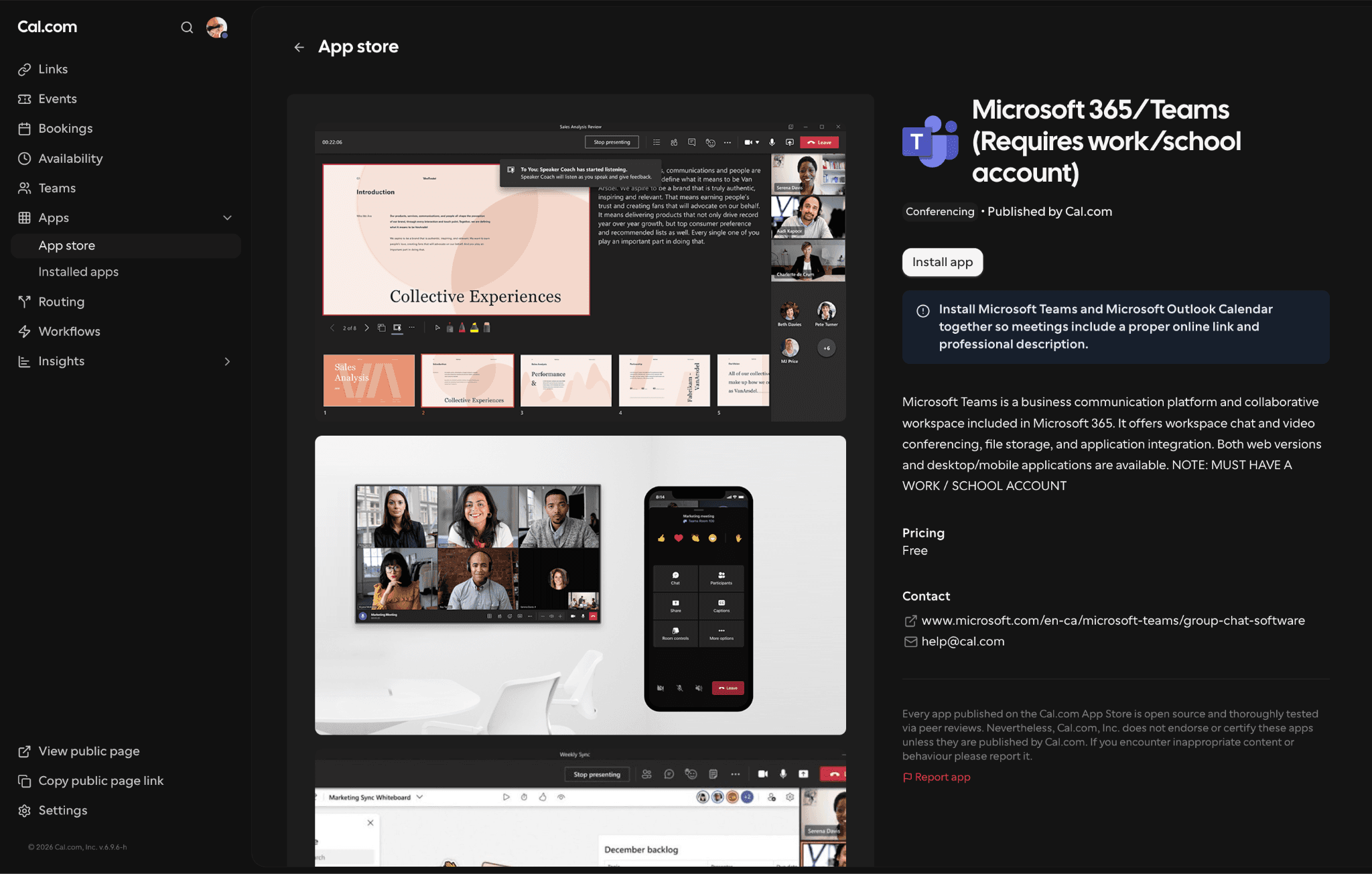
In the Cal.com sidebar, Apps opens into App store and Installed apps. This is the Microsoft 365/Teams listing inside the App store.
Open the Conferencing category, find Microsoft 365/Teams (Requires work/school account), and select Details.
Select Install app, then sign in with your work or school account and accept the permissions Microsoft asks for.
Install Outlook Calendar the same way, if you skipped it at sign-up.
To make Teams the default for every booking link, select Apps > Installed apps in the sidebar, then open Conferencing. Select the … button next to Microsoft Teams, then select Set as default.
To set Teams on a single booking link instead, select Links and open the link. On the Basics tab, open the location dropdown and choose Microsoft Teams under Conferencing. Select Save in the top-right corner.
To offer more than one option, select Add a location. If Teams isn't in the list, it isn't installed yet. The App Store link under the dropdown takes you back to step 2.
Booking links live under Links in the current Cal.com app. The Events tab next to it is for one-off events, such as a workshop or meetup, with their own registration page.
You can add as many conferencing options as you like and set a different one on each event type. With more than one location on an event, your guest picks the one they prefer at booking. That's handy when a client's IT policy blocks Teams and they need Zoom or Google Meet instead. Our pricing page lists Google Meet, Microsoft Teams, Zoom, Cal Video, and 20+ other conferencing tools.
None of this replaces your everyday Teams setup. It sits on top, covering the one gap native Teams doesn't handle on its own, giving outside people a way in. Teams building booking directly into their own product or website can also look at our API and Atoms, which expose the same scheduling logic as React components. If you're evaluating options beyond Microsoft Bookings, Cal.com is worth a look for round robin and routing alone.
Your next candidate doesn't need a fourth email. Create a free Cal.com account, connect Outlook and Teams, and send them a link instead.
How Much Does Microsoft Bookings Cost?
Microsoft Bookings doesn't have its own price. It comes included with eligible Microsoft 365 and Office 365 subscriptions, so you pay for the suite, not the booking tool. If your company already pays for one of those plans, Bookings costs nothing extra. If it doesn't, the cheapest way in is Microsoft Teams Essentials.
Microsoft raised most Microsoft 365 business prices on 1 July 2026. These are the new US list prices per user per month, from Microsoft's pricing update:
Plan that includes Bookings | Price with Teams | Price without Teams | Change on 1 July 2026 |
|---|---|---|---|
Microsoft Teams Essentials | $4.00, billed yearly | Not applicable | Not part of the increase |
Microsoft 365 Business Basic | $7.00 | $5.40 | Up from $6.00 and $4.40 |
Microsoft 365 Business Standard | $14.00 | $10.79 | Up from $12.50 and $9.29 |
Microsoft 365 Business Premium | $22.00 | $18.79 | Unchanged |
Office 365 E3 | $26.00 | $17.45 | Up from $23.00 and $14.45 |
Microsoft 365 E3 | $39.00 | $30.45 | Up from $36.00 and $27.45 |
Microsoft 365 E5 | $60.00 | $51.45 | Up from $57.00 and $48.45 |
Microsoft notes that list prices vary by country and currency. The full list of plans that include Bookings is on Microsoft Learn. It also covers A3, A5, E1, F1, F3, and government plans. The free version of Microsoft Teams isn't on that list.
So is Microsoft Bookings free? Only in the sense that it's already inside a plan you might pay for. There's no standalone free tier and no way to buy Bookings on its own.

What Cal.com's free plan includes, from the welcome screen new accounts see.
For a Microsoft 365 shop, that makes the price question a short one. You already own Bookings. The useful question is whether it does the job your external scheduling needs. Bookings stores its data in Exchange Online inside your tenant, and your existing Microsoft 365 compliance policies apply to it. For a simple public booking page, that's hard to beat.
It stops fitting when bookings need to reach the right person, not just any free person. That's where the Cal.com Teams plan at $12 per user per month, billed yearly, adds round robin, routing forms, managed event types, and booking analytics on top of your Microsoft 365 calendar. Individuals can use Cal.com free, with unlimited event types and calendars. Larger companies can move to Organizations at $28 per user per month for SAML SSO, SCIM, and role-based permissions. Our Enterprise plan adds a dedicated database, SLA and uptime guarantees, and dedicated onboarding and engineering support.
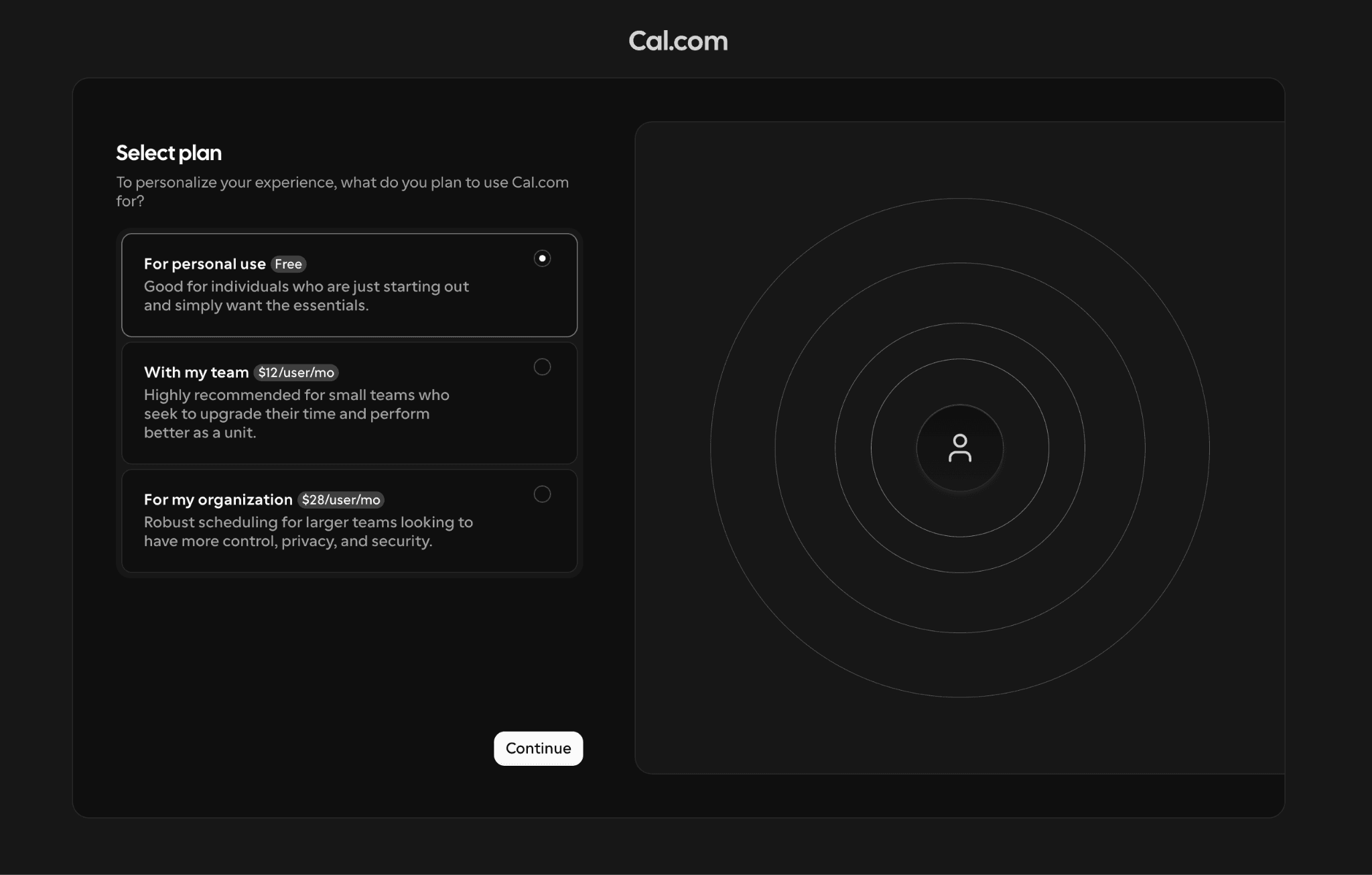
The Cal.com plan picker at sign-up: Free, Teams at $12 and Organizations at $28 per user per month.
Running a security review before you add a booking tool to your Microsoft 365 stack? Bring your questions to our sales team, and ask about SSO, SCIM, and where your booking data lives.
Native Teams Calendar vs. a Booking Tool: Which for What?
Use the native Microsoft Teams calendar for internal scheduling, and add Microsoft Bookings or another booking tool when external contacts need to self-book.

The Teams calendar vs Microsoft Bookings decision comes down to who needs access to your booking process and how far beyond your organization it needs to reach.
Job to be done | Native Teams calendar | Microsoft Bookings | A booking tool (e.g. Cal.com) |
|---|---|---|---|
Internal team meetings | Best fit | Overkill | Yes |
Channel and recurring team meetings | Handles this well | Not built for this | Yes |
See free/busy inside your org | Yes, via Scheduling Assistant | Yes | Yes, via 365 sync |
Public page for outsiders to self-book | No | Yes | Yes |
Share availability without adding directory guests | No | Yes | Yes |
Round-robin routing to the right person | No | Limited | Yes, weighted or fixed |
Routing form that qualifies a booker first | No | No | Yes |
Auto-create a Teams link on external bookings | Manual | Yes | Yes |
Price | Included with Microsoft 365 | Included with Microsoft 365, from $4 per user per month | Free for individuals, Teams plan $12 per user per month |
The table comes down to one question: Do the people booking your time already work inside your company? Internal scheduling stays within Teams, using the calendar you already rely on each day. External self-booking calls for Microsoft Bookings or a dedicated booking tool alongside Teams. Teams that need routing across multiple people and a fully branded booking page will usually favor a dedicated booking tool.
From learning how to add a calendar to Teams channel setups to managing external self-booking, native Teams handles internal scheduling on its own. If the Teams calendar vs Microsoft Bookings debate has been slowing you down, the table above should help you choose the right setup for your needs, with Cal.com right by your side.
When to Use Native Teams vs. Microsoft Bookings vs. a Dedicated Tool
The right Teams scheduling option depends on who you schedule with and how much automation your workflow needs. For internal meetings, native Teams keeps scheduling simple. As external bookings become more frequent or complex, Microsoft Bookings and dedicated scheduling tools add more control.
For internal team meetings, native Teams handles scheduling without extra setup. Use it for standups, team syncs, one-on-ones, and other meetings where every attendee already belongs to your directory.
For small teams with occasional external clients, Microsoft Bookings adds a straightforward self-booking option. It connects with your Outlook calendar and gives external contacts a public booking page without adding them as guests.
For heavy external scheduling with routing needs, a dedicated tool like Cal.com offers more advanced workflows. It can route bookings by role or location, collect information through qualification forms, manage multi-step intake, assign meetings through round-robin scheduling, and support a fully white-labeled booking page. Native Teams and Microsoft Bookings do not offer the same depth of scheduling controls.
Two of our customers show what that third case looks like in practice. At Storyblok, a handful of engineers were taking 90% of demo bookings across a team in 40+ countries. After the move to fixed round robin, demo efficiency rose 50%. Reda runs several brands under one roof and routes every booking to the right team with that team's own branding. It saves about 20 hours a month that used to go on coordinating by hand.
Not sure which case you're in? Start a 14-day Cal.com Teams trial, point a round-robin event at your Outlook calendars, and count how many bookings land on the right person in the first week.
Frequently Asked Questions About Microsoft Teams Calendar
Is There a Calendar in Microsoft Teams?
Yes. Microsoft Teams has a built-in calendar on the left side of the app, and it's the same calendar as your Outlook calendar. If you don't see it, select More apps (the "…" icon) and pin Calendar. The calendar needs an Exchange Online mailbox, so it may be missing if your Microsoft 365 license doesn't include one.
Is the Teams Calendar the Same as the Outlook Calendar?
Yes. The Microsoft Teams calendar and the Outlook calendar read the same Exchange Online mailbox, so every meeting appears in both. You don't need to integrate or sync them yourself. If a meeting shows in one app and not the other, check that Teams is pinned, your license is active, and the Teams Meeting add-in is enabled in Outlook.
Where Do I See My Teams Calendar?
On desktop and the web, select Calendar on the left side of Teams. In the Teams mobile app, tap Calendar in the bottom bar. The mobile app shows an agenda view of upcoming meetings and doesn't show channel calendars.
Can Everyone See My Calendar on Teams?
People in your organization can see when you're busy, but not your meeting titles or details, unless you or your admin share more. You can give a specific person more access through Calendar > More options > Share. People outside your organization can't see your calendar unless you share it with them or send them a booking page.
Can Your Boss See Your Teams Calendar?
Your manager sees the same thing as anyone else in your organization by default, which is when you're busy, not what you're doing. They see more only if you share your calendar with them at a higher access level, make them a delegate, or your admin has changed the organization's default.
What's the Difference Between the Channel Calendar and the Group Calendar in Microsoft Teams?
A channel calendar is a filtered view of the Microsoft 365 group calendar behind the team. It shows only one channel's events, and you can use it only in Teams. The group calendar shows every event for the whole team, and you can also open it in Outlook under Groups.
What Is the Best Calendar to Use in Teams?
For internal meetings, the built-in Teams calendar is the best choice, because it's already your Outlook calendar and every meeting gets a Teams link. For people outside your company, add a booking tool on top of it. Microsoft Bookings covers simple public booking pages. Cal.com adds round robin, routing forms, and workflows, and it still creates a Teams link on every booking.
Why Use Teams Instead of Outlook?
You don't have to choose. Both apps show the same calendar, so a meeting you schedule in one appears in the other. Use Teams when you need a channel meeting or a channel calendar, because channel events can only be scheduled and viewed in Teams.
Can External People See My Teams Calendar Availability?
External people can't see your Teams calendar availability by default. Scheduling Assistant shows availability for people inside your Microsoft 365 organization. To let external contacts book time, you can share your Teams calendar with external users through a booking layer such as Microsoft Bookings or Cal.com. Both options can present available slots through a dedicated public page while keeping your calendar private.
Can I Book a Meeting on Behalf of Someone Else in Teams?
The Teams calendar itself doesn't give you a "schedule for someone else" option. If you need this capability, the other person can give you delegate access to their calendar in Outlook. You can then create Teams meetings on their calendar, and the invite shows as sent on their behalf. For a more automated version, a dedicated booking tool with routing features can automatically assign an external booking to the right person based on role, availability, or a quick qualification question, without anyone manually updating individual calendars.
Why Don't Recurring Channel Meetings Show Up on New Members' Calendars?
A Microsoft Teams channel calendar only writes recurring events to the calendars of people who joined that channel before the series began. Someone who joins later can see the channel itself and browse its full chat history, but the recurring series never appears on their personal calendar on its own. Add a new hire or a late addition to the invite directly when they need the standing meeting, or send an update to the series so Teams re-sends it. Counting on channel membership alone won't put it on their calendar, no matter how many past conversations they can see.
What's the Difference Between the Teams Calendar and Microsoft Bookings?
The difference between the Teams calendar and Microsoft Bookings comes down to who needs to book time. The Microsoft Teams calendar handles scheduling for people inside your organization. Microsoft Bookings adds a public page where people outside your company can view available slots and book time themselves. The Teams calendar vs Microsoft Bookings choice comes down to your audience, from internal colleagues to external contacts.
How Much Does Microsoft Bookings Cost?
Microsoft Bookings has no price of its own. It's included with eligible Microsoft 365 and Office 365 subscriptions. After Microsoft's 1 July 2026 price update, the cheapest US options are Microsoft Teams Essentials at $4.00 per user per month, billed yearly, and Microsoft 365 Business Basic at $7.00 per user per month. Business Standard costs $14.00, and Business Premium costs $22.00.
Is Microsoft Bookings Free?
Microsoft Bookings is free only if you already pay for a Microsoft 365 or Office 365 plan that includes it. There's no standalone free version, and the free version of Microsoft Teams doesn't include Bookings. Cal.com is free for individuals, with unlimited event types and calendars, and it connects to Outlook and Microsoft Teams on the free plan.
Can I Use Microsoft Teams With Cal.com?
Yes. Cal.com connects to Microsoft Teams through its App Store, and each booking gets a Teams meeting link automatically. You need a Microsoft work or school account to connect it. Install the Outlook Calendar app alongside it so bookings also land on your Microsoft 365 calendar.
Does a Booking Tool Still Create a Microsoft Teams Meeting Link?
Yes, a booking tool can still create a Microsoft Teams meeting link. Tools like Cal.com connect to your Microsoft 365 calendar and automatically generate a genuine Microsoft Teams link with every booking. Guests get a normal Teams meeting invite, and they never need an account or guest access inside your organization's directory. Between the six steps above and the booking process, you now know how to schedule a meeting in Microsoft Teams for both internal and external meetings.

Get started with Cal.com for free today!
Experience seamless scheduling and productivity with no hidden fees. Sign up in seconds and start simplifying your scheduling today, no credit card required!